How to Onboard Remote Employees
As remote/ hybrid working becomes the new norm, many employers are now having to digitise their onboarding programmes for remote workers. In this guide, we examine the challenges and opportunities associated with remote employee onboarding programmes. Read on to discover top tips and tricks on how to onboard remote employees.
Table of Contents
- What is Employee Onboarding?
- The Value of Employee Onboarding
- The Rise of Remote Working in 2020
- How Do Remote & Onsite Onboarding Programmes Differ?
- Challenges Associated with Remote Employee Onboarding
- Ways to Improve Your Remote Onboarding Programme
- 10 Remote Team Building Activities
- What are the Keys to Successful Remote Onboarding?
- Key Takeaways
What is Employee Onboarding?
Onboarding refers to the process of orienting newly-hired employees with the knowledge, skills and behaviours they need to successfully assimilate into their position and the organisation. According to HR Toolbox: “Onboarding begins from the moment an offer is made to the employee until the time the employee becomes a productive member of the organization”. Typically, the onboarding process aims to familiarise the employee with:
- The tasks and responsibilities tied to their job role
- Their new colleagues
- Organisational values and policies
- The workplace culture

The Value of Employee Onboarding
“You never get a second chance to make a first impression.”
For the employee, onboarding provides an opportunity to familiarise themselves with a new environment. From an employer’s perspective, onboarding is a valuable process during which they can share all of the essential information the new hire will need to be successful in their job.
Research highlights the immense importance of a well-structured onboarding programme. Companies that have a strong onboarding process boost new hire retention by 82% and productivity by over 70%. Yet, according to Gallup just 12% of employees strongly agree their organisation does a great job of onboarding new employees.
The Rise of Remote Working
Before the COVID-19 crisis, 14% of Irish employees worked from home in some formal capacity, either sometimes, or usually. Data from the CSO reveals that of those workers whose employment has been impacted by the pandemic, 34% have started remote working from home and 12% have increased their number of hours remote working from home.
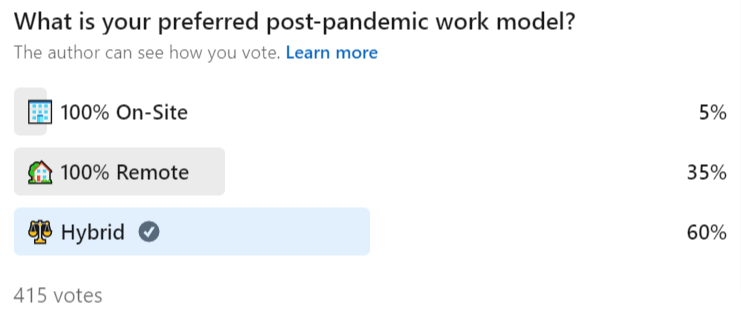
LinkedIn poll conducted by Berkley in October 2021
Before the pandemic, remote working was trending upwards due to digitisation, improved infrastructure, lack of office space, and local skill shortages. However, many employers still viewed remote working with suspicion:
“The reluctance by many employers up to now to allow agile working was born out of a fear that their business model could not be adapted to cater for it, coupled with concerns that any such change would cause inefficiencies”
– Ciara Ruane, The Irish Times
The forced flexibility brought on by the lockdown has given many employers a chance to rethink their attitude towards remote working. As a result of adopting remote working practices, many organisations have seen a productivity boost. In fact, the Whitaker Institute found that 30% of remote workers reported that their productivity increased while working remotely during COVID-19. Remote working also improves employee morale, as some team members may find that working from home makes it easier to manage their personal commitments. In addition, companies can enjoy lower overhead costs as they do not have to pay to maintain office space.
How Do Remote & Onsite Onboarding Programmes Differ?
The increase in remote working brought about by the ongoing COVID-19 crisis has seen a general rise in remote onboarding practices. Remote onboarding involves using digital tools such as WorkVivo to assimilate remote employees into the organisation. Like on-site onboarding, remote onboarding aims to give employees the knowledge and tools they need to succeed in their role while also helping them to socialise with their co-workers. It is also a chance to share your remote work policy, define clear expectations, and set ground rules.

Challenges Associated with Remote Employee Onboarding
When it comes to learning how to onboard new remote employees, you need to first reflect on the unique challenges that new remote hires face.
Fighting “Out of Sight, Out of Mind”
Oftentimes, remote employees fall into the category of “out of sight, out of mind.” Neglecting remote workers leads to lower morale, poor engagement and a feeling of mistrust. As such, it’s imperative to maintain open and active communication from the very start.
Combating Social Isolation
Another challenge is figuring out how to humanise the virtual onboarding process in a way that brings people together. While digital tools provide a fast and efficient way of transferring information, they lack a human touch. Many remote workers struggle with isolation and a feeling of disconnectedness. To ease the socialisation process, it’s crucial to investigate how your organisation can leverage digital tools to create a supportive network.
Addressing Technological Gaps
Furthermore, organisations shouldn’t expect that just because a new hire has agreed to work from home that they have all of the equipment they need to hit the ground running. Treat new remote workers just as if they were working in the office. In other words, make sure that they have all the gear they need in order to be as productive when working from home. This will require a good deal of organisation on your part as you identify their needs, order home office equipment and arrange for delivery. Ideally, this should take place before their start date so they can get started with minimal delay.
Safeguarding Employee Health and Wellness
Working from home can take a toll on the mental and physical health of remote workers (especially those who are new to it). Data from Glassdoor UK shows that:
- 40% of workers have experienced heightened anxiety since the beginning of Covid-19 restrictions in the UK
- 34% have experienced more sleeplessness
- 22% are experiencing greater levels of depression
With this in mind, employers should incorporate health and wellness initiatives into their onboarding process to tackle common issues such as work-life balance, sedentary lifestyles, stress and isolation. Some examples of initiatives include online yoga or fitness classes, well-being training, mindfulness and meditation programmes and counselling.
Ways to Improve Your Remote Onboarding Programme
Introduce a Buddy System
A buddy system involves appointing an experienced teammate to guide a new employee through the onboarding process. Buddies play a complementary role to managers and mentors as they have a more informal relationship with the new hire. They offer the newbie information that the employee handbook can’t provide. Buddy systems help new remote workers to feel more connected to the organisations and may also help to mitigate their initial loneliness.
When Microsoft trialled a new buddy system they found that:
- 56% of new hires who met with their buddy at least once in their first 90 days indicated that their buddy helped them to quickly become productive in their role.
- New hires with buddies were 23% more satisfied with their overall onboarding experience compared to those without buddies.
Launch an Online Portal
Another good idea is to set up an onboarding portal online. This would act as a “one-stop-shop” providing everything a new hire needs to get started such as e.g. forms, employee booklets and documentation. Providing a permanent home for this content ensures that new team members can learn at their own pace and revisit the content whenever they have a question. What’s more, it also streamlines admin as all of the digital paperwork can be accessed and submitted in one centralised location.
Arrange Regular Virtual Team Building Activities
“The physical distance of remote work can quickly turn into emotional distance which in turn, leads to isolation. And when your employees feel isolated, they won’t be comfortable working alongside their fellow team members! This is why it’s important to create a comfortable team environment that remote workers can rely on.”- Peter Banerjea, Time Doctor
Regular social activities give new remote hires a chance to get to know their colleagues in a more relaxed setting. To ensure a steady flow of activities, set up a social calendar in a central location and make sure that everyone can add their own events. To prevent “Zoom fatigue”, make an effort to think outside the box and incorporate a variety of formats.
10 Remote Team Building Activities
- Video call quizzes, charades or bingo
- Live puzzles (e.g. puzzles, jigsaws, sudoku)
- Online board games
- Video game tournaments
- Party games such as Jackbox or online Pictionary
- Shared interest groups e.g. book clubs, craft groups
- Live virtual office
- Virtual breakfast, lunch or coffee meet-ups
- Health challenges
- Online fitness classes
What are the Keys to Successful Remote Onboarding?
Clients frequently ask us about how to successfully onboard remote employees. When it comes to developing and implementing remote onboarding programmes, employers need to be innovative, open-minded and flexible. To instil a sense of belonging amongst new remote hires, employers need to figure out how to maintain a consistent flow of two-way communication. You also need to consider how you can overcome the challenges posed by physical distance to create a sense of stability and accessibility.
Above all, it’s important to inject your onboarding programme with empathy. The ongoing pandemic is a stressful time and many people are still adapting to the “new normal”. In these uncertain times, there is heightened dependence on those in management and leadership positions to promote the well-being, health and safety of their workforce. As such, it is up to employers to set the tone in their organisation and lead with empathy.
Key Takeaways: How to Onboard Remote Employees
Starting a new remote role comes with a set of many unique challenges, so getting the onboarding process right is key to helping new hires get off to a strong start. Remote working is unlikely to go anywhere soon, so it is well worth investing time and effort into developing an onboarding process that is specifically tailored to the unique needs of new remote employees. For more expert advice on how to onboard remote employees, reach out to Berkley’s Recruitment Consultants today.