The Right Time to Move | From Umbrella Company to Your Own Personal Limited Company [Webinar Transcript]
This webinar, “Contracting Expenses: What Can I Claim”, is the second episode of a four-part series focusing on contracting in 2022. In this session, Gillian Buckley – the Contractor Care Specialist at Berkley – is joined by Sean Piggott – Business Development Manager at Icon Accounting.
Webinar Transcript
- Moving from an Umbrella Company to a Personal Limited Company
- When is the Right Time to Make the Switch?
- Why Make the Move?
- What Are The Main Differences Between an Umbrella Company and a Personal Limited Company?
- What Are The Additional Benefits of Switching, If Any?
- The Impact on your Payslip
- Sean’s Top 4 Tips
Moving from an Umbrella Company to a Personal Limited Company
Regardless of who your provider is, moving from an Umbrella Company to your own Personal Limited Company should be a seamless experience that causes no interruption in pay or service.
It is worth noting that setting up your Personal Limited Company can take anywhere from 4 to 8 weeks, depending on the CRO backlog. In other words – it will be two monthly invoices before your company is ready to use. Although you will have your Certificate of Incorporation back within 7 – 10 working days, the vast majority of the delay is caused by the tax registration that happens after you get this cert.
It is also worth noting that if you are currently on a Stamp 1G, the Personal Limited Company structure is not an option. However, this option is open to people who are on a Stamp 4 Visa.
When is the Right Time to Make the Switch?
Honestly, you are best positioned to answer this question because it completely depends on your personal circumstances.
From Icon Accounting’s perspective, we typically advise an umbrella company to candidates’ who are contracting for the first time. Why is an Umbrella Company Structure better suited to new contractors?
- You will have a dedicated Account Manager for queries
- Gives you an opportunity to get used to what is required in the World of Contracting
- Less administrative duties
- Less responsibility RE: Year-End returns
- Whereas it is free to set up an Umbrella Company, there is a cost to set up and cost to close a PLC
If you are considering making the change from an Umbrella Company to a Personal Limited Company, your accountant should be able to advise on your scenario in more detail. Over the course of this webinar, we will examine and discuss some of the most common reasons why people decide to make the switch.
What Are The Main Differences Between an Umbrella Company and a Personal Limited Company?
Firstly, both an Umbrella Company and the Personal Limited Company are Private Limited Company structures. The main differences in terms of set-up are outlined below:
- With a PLC, you are responsible for choosing a company name
- Time to set up – VAT, PAYE & other relevant taxes (typically 4 – 8 weeks)
- You will require a business bank account
- You will need to appoint a Company Secretary (usually a close family member or a third-party service)
- Registered business address (home address or third-party service)
- Class S PRSI & Income Tax Return
Why Make the Move?
There are plenty of reasons to consider making the switch to your own Personal Limited Company. Some of the most common reasons are:
- Further tax efficiency
- Employing a family member
- Purchasing a company vehicle/large business assets (e.g. office space)
- Investments outside of pensions
- Multiple business interests
- Payments in Cryptocurrency/Shares
- Avail of additional reliefs (e.g. Entrepreneurial/Retirement Relief)
Further Tax Efficiency
First and foremost, and arguably, the most popular reason for making the switch is to retain more of your income. In an Umbrella Company structure, the total invoice value is processed as payroll, whereas, in a Personal Limited Company, you can set your salary to reduce the amount of Income Tax that you are paying on a month-to-month basis.
Employing a Family Member
The option to employ a family member is also quite popular with Independent Professional Contractors is also quite popular. This can be a family member/friend in any capacity, but please keep the below in mind:
- The remuneration paid should be in line with the duties carried out. This is an area where Revenue is particularly stringent.
- This will have an impact on their taxes in 99% of cases – if they are already earning income, make sure it actually benefits before proceeding.
Purchasing a Company Vehicle/Large Business Assets
Many long term Contractors will look to purchase/lease a company vehicle or other large assets such as property. These are both discussions that you should have with an advisor before proceeding to set up your company based on:
- Benefit in Kind
- Investment Income Corporation Tax
- Capital Gains Tax
Investments Outside of Pensions
Similar to the above point, many long term Independent Professionals will look to invest additional funds saved by utilising the Personal Limited Company in company shares.
Note: Investment Income Corporation Tax is not 12.5%, instead, it is 25% and this can be a deal-breaker on becoming the next Warren Buffet!
Multiple Business Interests
Independent Professionals are often very good multi-taskers and as a result, plenty has additional business interests. This can come in a variety of formats such as:
- Another consultancy – always check the contract!
- E-commerce
- Freelance work such as Fiverr or Upwork
Payments in Cryptocurrency/Shares
As the rise in Cryptocurrency continues to unfold before our eyes, some clients will offer payment in this format. An umbrella company is not set up to facilitate such payments and therefore a Personal Limited Company may be the best option. Likewise, if you are starting a new role in a start-up company, they can often try to seduce you by adding a % share as part of your payment. Again, the umbrella company would love to have shares in the next Revolut, but it isn’t set up to facilitate such agreements.
What Are The Additional Benefits of Switching, If Any?
If the previous slides haven’t yet convinced you, a Personal Limited Company may not be for you and that is absolutely fine! Like most decisions in life, there are pros and cons to weigh up and consider before making the final call.
In my opinion, the main benefits of moving to a PLC are:
- Opportunity to become even more tax-efficient
- Employing a family member can increase the take-home pay for the overall household/family
- Retained profits can be put to good use
- A company Tesla sounds nice, right?
- Increased flexibility with business expenses!
- Reliefs available such as Entrepreneurial/Retirement
The Impact on your Payslip
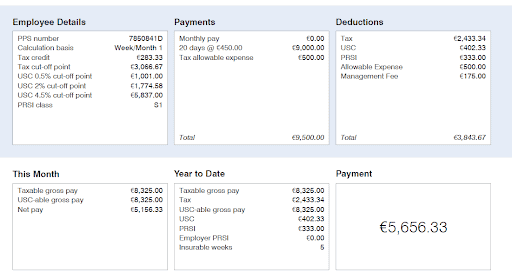
Example 1: In the below payslip, the contractor is operating under an Umbrella Company structure. They are charging a day rate of €450 and are contributing €500 to a pension scheme. Their total income-related taxes paid comes to € 3,168.67.
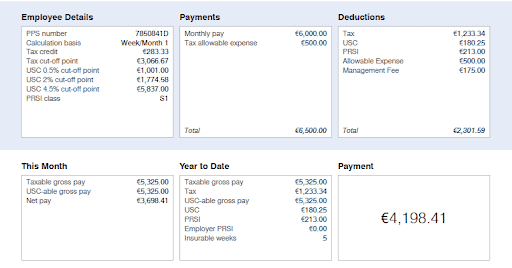
Example 2: In the below payslip, the contractor is operating under a Personal Limited Company. They are charging a day rate of €450 and have set a yearly salary of €72,000. They are also contributing €500 a month towards a pension scheme. Their total income-related taxes paid comes to €1,626.59.
- Difference in Income Taxes Paid – €1,542.08
- Difference in Take Home Pay – (€1,457.92)
- Difference in Business Bank Account = + €3,000
Top 4 Tips
- If you aren’t sure, speak to your provider and they can advise on your scenario!
- Remember that there is more than likely some additional work associated.
- Retained Profits aren’t tax-free – Corporation Tax still applies!
- Log in to the next Lunch & Learn session to find out more about the Reliefs – you don’t want to miss it!
Sign Up for Our Next Webinar
If you’re interested in learning more about how to maximise your take-home pay as a contractor, why not sign up for our free webinar “Entrepreneurial Relief | What Contractors Need to Know.” Click here to save your seat!