Ghosting: What is It & How Is It Affecting Your Company’s Candidate Experience?
In today’s fast-paced recruitment market, the phenomenon of “ghosting” is becoming increasingly prevalent. Read on to learn more about how ghosting can hamper your hiring efforts in 2022.
Table of Contents
What is “Ghosting”?
A crossover term from the dating world, “Ghosting” refers to the practice of ceasing “all communication and contact with another person without any apparent warning or justification and subsequently ignoring any attempts to reach out or communication made by said person” (Wikipedia).
In the recruitment world, the phenomenon of ghosting has become a major pain point for candidates and employers alike. Ghosting can happen:
- When job applicants drop out of interviewing or onboarding processes without notifying the employer.
- When organisations cease all communications with job candidates upon deciding that they are not the right fit for the role in question.

Candidate Ghosting By Employers
Statistics About Candidate Ghosting
- 75% of applicants never hear back from employers after applying for a job. (Source: Human Capital Institute)
- 60% of candidates never hear back from employers after attending an interview. (Source: Human Capital Institute)
- 80% of job seekers say they would not reapply to a company that didn’t notify them of their application status (Source: Lever).
Communicating With Unsuccessful Candidates
The proliferation of online job search tools has greatly increased the number of applications employers typically receive. If a role receives many applications, then it can be difficult to stay on top of communications. As such, many employers tend to forget about unsuccessful job applicants.
One way to avoid this from happening is to employ the services of a recruitment consultancy such as Berkley. The consultants will engage candidates on your behalf and ensure a steady stream of communication and updates. This, in turn, will help to protect your employer brand.
While there is no legal requirement to communicate with unsuccessful candidates, there are many reasons why you could incorporate this practice into your recruitment lifecycle:
- It is considerate to provide closure to candidates as it shows a basic respect for the time and effort invested into their application.
- It helps to maintain goodwill with candidates, and thereby helps to protect your employer brand and reputation.
- You can add Silver and Bronze Medallists to your talent pool and leave the door open for future opportunities. For example, here at Berkley, Silver and Bronze medallists comprise a key part of how we grow our talent pools. This helps to ensure that our consultants and our clients have access to top professionals.
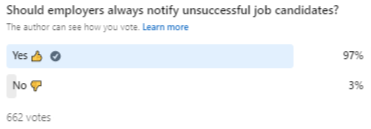
Stop Ghosting Candidates Today By Creating A Positive Rejection Process
Rejecting Candidates Whose CVs Didn’t Make the Cut
It’s best practice to notify candidates even if they are rejected at the earliest stages of the recruitment process. Fortunately, the emergence of ATS technology means that it is easy to automate this process even if you receive a large number of applications.
This time-saving technology means that you can put more energy into creating a thoughtful rejection notice. When it comes to writing rejection letters, your guiding principles should be clarity and brevity. Start the email by thanking the applicant for taking the time to apply. You can then clearly state that you have decided not to proceed with their application. As this is still early days, you do not get into specifics about the reasoning behind your decision.
Rejecting Candidates After A Job Interview
If a candidate has put time and effort into attending a job interview with you, then you do owe them a more comprehensive response. We recommend that the news is broken over a phone or video call as it is a more personal mode of communication.
If you have engaged the services of a Recruitment Consultancy, the Consultant will notify the candidate on your behalf. In many cases, the consultant will have developed a relationship with the candidate and will know how to deliver the news in a way that softens the blow.
You should manage expectations by getting straight to the point. Thank them for taking part in the process and then clearly state that you have decided not to proceed with their application. You should be ready to provide both positive feedback and constructive criticism to the candidate about their application. End the interaction on a positive note by wishing them well in their job search and by offering to keep them in mind for any suitable roles that may arise in the future.
Employer Ghosting By Candidates
Why Do Candidates Ghost Employers?
In a strong candidate market, top professionals are likely talking to multiple employers. According to data from Indeed, 40% of candidates ghost when they receive an offer from another company. If the other offer provides a more lucrative compensation package, then the candidate is likely to take it and never look back. Read our dedicated guide to learn more about how to design an unbeatable compensation package for employees that may help put an end to employer ghosting.
Candidates are more likely to ghost an employer if the hiring process so far has been characterised by poor and slow communication. Our own research shows that 43% of candidates would wait for a maximum of two weeks to hear back from an employer before considering the job a lost cause and moving on.
On a similar note, candidates are more likely to ghost a potential employer if the hiring process is too long and complicated. In a survey, Berkley found that a whopping 81% of respondents have dropped out of a hiring process because it was too long.
How to Prevent Employer Ghosting
While you cannot control the behaviour of candidates, you can design a hiring process that reduces the conditions that can often lead to ghosting.
Remember that other organisations may be courting the same candidates as you, so your first priority should be speed. Assess your current hiring process and identify opportunities for streamlining. For a comprehensive guide on this, check out our post “10 Ways to Reduce Time-to-Hire.”
This applies to the Offer Stage as well. When you have found the right candidate – make sure that you have everything in place to make an offer asap. Anticipate some negotiation and prepare your conditions in advance. If a higher salary is out of the question, then look at other areas where you can sweeten the deal such as benefits and flexible working.
In order to keep candidates engaged throughout the process, , it’s important to ensure consistent, clear and timely communications with a focus on clarity and transparency. Here are some ways you can use communication to keep candidates engaged:
- Keep the candidate in the loop by sending frequent updates on their application status. If you’re working with a consultancy, they will do this for you.
- During the early stages of the hiring process, use an automated solution to send prompt and timely templated communications.
- Phrase your messages in a way that encourages a response.
- Manage candidate expectations by providing clarity on timelines.
- Clearly outline what the interview process will look like from the outset.
What to Do If A Candidate Ghosts You
If you are ghosted by a candidate, we advise that you make several attempts to follow up. Give them the benefit of the doubt initially, as life happens and things sometimes get in the way. Use the candidate’s preferred contact method but switch it up if that’s not working. Give yourself a hard deadline after which you can cut your losses and move on to the next candidate.
One way to mitigate the effects of candidate ghosting is to work with a trusted Recruitment Partner. They will try to follow up with the candidate for you. In the case that the candidate remains uncontactable, the Consultant will be able to source alternative candidates.