What Salary Am I Worth?
Constantly fluctuating salaries means that it can be challenging to determine your worth. However, it’s important to know your value in order to make sure that you are receiving a fair and competitive compensation package. To learn more, read our guide below on how to figure out what salary you are worth.
Table of Contents
Why It’s Important To Know What Salary You’re Worth
“Understanding your own worth is very important. If you don’t understand your worth and the value you bring to your employer, why should anyone else?”
~ “Understanding Your Professional Value”, INCORP
Knowing your worth is key to ensuring steady salary growth throughout your career. In fact, a study featured in the Journal of Organisational Behaviour has revealed that a 25-year-old employee that starts at $50,000 would earn $634,198 less than an employee starting at $55,000 by the time they reached the age of 65. As such, it’s important to factor up-to-date and achievable salary goals into your career plan.
Having a good knowledge of your worth will empower you to weigh up job opportunities and negotiate better wages throughout your professional life. Cultivating this knowledge is particularly important for groups that are more likely to be underpaid such as entry-level workers, women and people of colour.
4 Ways to Figure Out Your Worth
1. Download Salary Guides
Salary guides offer the most effective way of researching your worth. For the best overall picture, download several salary guides from a few different sources and cross-reference the figures. You can get started by downloading Berkley’s most recent salary guide reports. Alternatively, you can discover average market rates for your role in the contracting space by downloading our 2022 Contracting Rate Reports.
2. Talk To A Recruiter
You can also learn more about average salaries by talking to a recruitment consultant. We recommend finding an experienced recruiter who specialises in your field. A specialist consultant can also tell you about contracting rates for that position in case that is a path you are interested in pursuing. Visit this page to arrange a free consultation with one of Berkley’s specialist recruiters.
3. Look Up Similar Job Listings
Amid calls for greater pay transparency, a growing number of employers are featuring salary bands in their job ads. As such, it is now much easier than ever to discover the going rate for your role. For the most comprehensive view, we recommend searching across a number of different job boards.
4. Ask Your Network
If you have many connections, it may be worth asking your network for general salary trends and information in your field. However, bear in mind that this information is more likely to be based on opinion than fact.
What Factors Affect Your Earnings?
Location
When determining the salary for a role, employers must consider local living costs.
As a rule, employers in city-centre locations generally offer much higher wages than rural areas. For example, Dublin workers earn 15% more than their counterparts in other counties in order to compensate for higher accommodation, food and transport costs.
Furthermore, areas featuring business clusters (defined by Wikipedia as “a geographic concentration of interconnected businesses, suppliers, and associated institutions in a particular field”) tend to offer more competitive salaries in order to attract top talent
However, it is worth noting that the rise of remote working in recent years has led to calls for decentralised pay scales. In the future, geography may not have such a strong influential effect on salaries.
Company Size
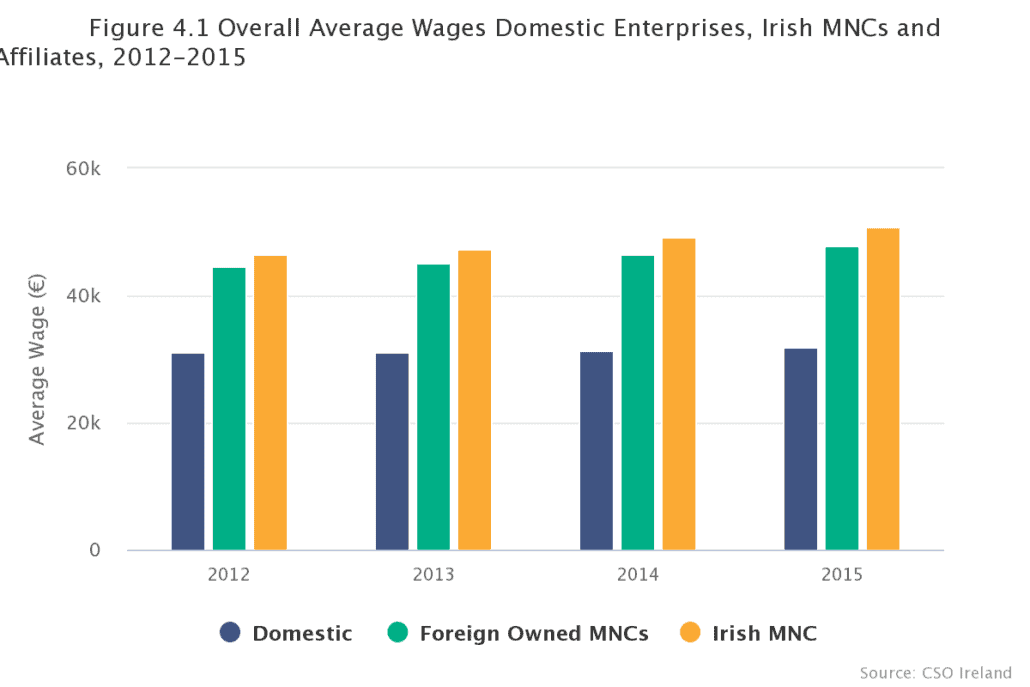
In Ireland, people employed by large multinationals tend to earn more than those employed by domestic SMEs. For example, CSO research has revealed that people working for US multinationals earn almost double the average industrial wage. These large companies offer higher salaries and more comprehensive benefits because they generally have the resources to do so. However, we are finding now that many smaller organisations are combatting this by using perks creatively when paying more isn’t possible.
Skill Supply & Demand
Severe skills shortages have led to a market in which employers fiercely compete against each other for top talent. Organisations wishing to remain competitive need to pay big bucks to hire for in-demand skills while also retaining current employees by offering pay rises and counter-offers when appropriate.
However, research from Grant Thornton has found that a shortage of skilled workers has been identified as a constraint to growth by 37% of Irish businesses. So why is this? Ireland’s talent pool has shrunk while our economy has grown, so the demand for labour has gone up. This has been exacerbated by the pandemic as the net migration of skilled workers has fallen to an all-time low.
As a result of this, candidates with niche, in-demand skills can command higher salaries at every level of their career. They are also more likely to turn down job offers as a result of receiving lucrative counter-offers from employers.
What are some of the most in-demand roles in 2021?
Engineering: Process, Automation, Validation, Ehs, Quality, Regulatory, Manufacturing, Chemical, Electrical, Maintenance Engineers And Technicians.
IT: Software Developers, Analysts, Designers, Engineers, Architects, Technical Support Staff.
Experience
As you progress in your chosen career and gain experience, your earnings should continue to grow. Candidates with a high level of skill, knowledge and business acumen built over years in the job are deemed to be highly valuable.
What’s more, your experience is inextricably linked with your reputation. Typically, the more experience you have, the better you’re reputation will be. As your reputation develops, there will be more employers who will be willing to pay top dollar for your services.
Typically, top earners within an occupation will have 10+ years of experience. These senior candidates are highly sought-after as they offer a level of hard-won expertise and insight that can have a transformational effect on an organisation.
“In the business world, everyone is paid in two coins: cash and experience. Take the experience first, the cash will come later.”
~ Harold S. Geneen
Education Level
Research has confirmed that earned income typically increases with your education level. For example, data from the CSO reveals that the median earned income for PhD-holders was almost five times higher than that of a person with no education. This is particularly the case in Ireland, where the earnings advantage for adults with a third-level qualification is larger in Ireland than on average across OECD countries.
If your income is stagnating then it may be time to look into upskilling. The key to unlocking a higher earning potential through learning is to think shrewdly when choosing courses and to stay ahead of the technical curve.

Type of Role
The type of role you work in can also influence how much you earn. For example, contractors typically earn higher gross pay than permanent employees. This is because contractors are usually employed on a short-term basis. Contractors’ higher pay also compensates for the fact that they do not receive employee benefits such as sick pay or annual leave. Furthermore, contractors are paid for every hour/day that they work whereas permanent employees are paid a salary that may not cover hours worked in overtime.
What’s more, by engaging the services of a specialist tax accountancy firm contractors can further maximise their take-home pay. Specialist tax accountants achieve this by making limited company structures as tax-efficient as possible while also offsetting business expenses against the contractor’s income. To learn everything you need to know about making the switch to contracting, visit Berkley’s dedicated Contractor Hub.
How to Communicate Your Worth to Potential Employers
“The worst financial transaction you will ever make is selling yourself short.” ~ Greg Gilbert
Once you have researched salaries, the next step is to learn how to communicate your worth to potential employers. When applying for a promotion or a new job, you need to market yourself as if you were a business. To stand out as an applicant you need to be able to clearly articulate the value you offer based on the criteria the employer has defined. Confidence is key here. If you’re going to ask for more money, you have to truly believe you’re worth it. Once you have demonstrated that you could be a valuable asset to the company, then you should be able to easily justify your worth in terms of salary.
Key Takeaways: What Salary Am I Worth?
To ensure that your earnings stay on track throughout your career, it’s important to cultivate a strong understanding of your worth. In order to do this, you will need to do your homework by researching the going rates on the market and by factoring in the various things that could potentially affect your salary. However, the work doesn’t stop there – you must also be able to confidently and effectively communicate your worth and value to potential employers. For more salary tips and tricks, contact Berkley today and talk to one of our expert consultants!