How To Tailor Your CV To A Job Description
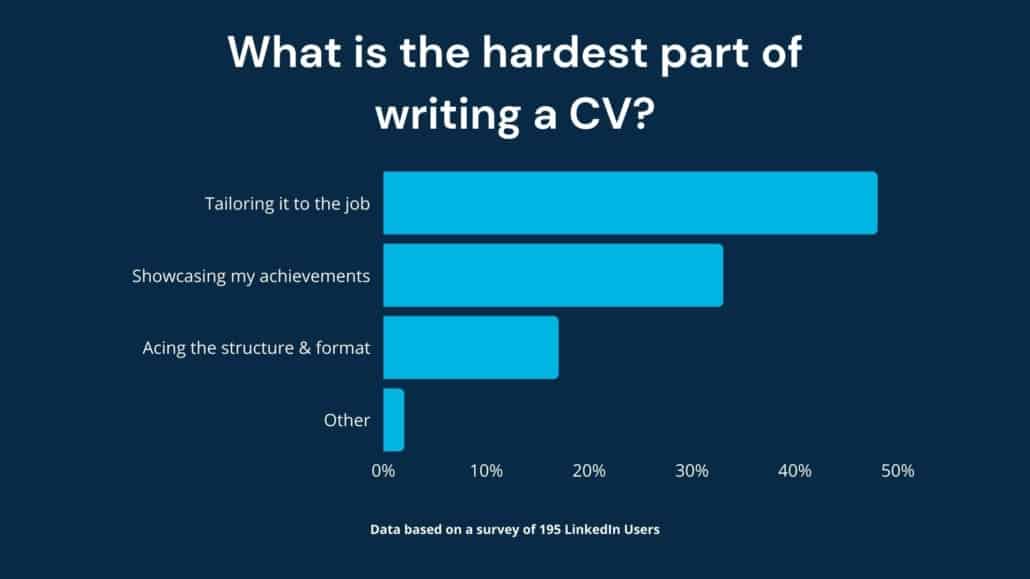
In 2021, Berkley ran a LinkedIn poll about the hardest part of writing a CV to which 48% of respondents said “tailoring it to the job”. In this article, we will explain why it’s important to learn how to tailor your CV to every job application and we will walk you through a step-by-step guide on how to customise your CV to a job description.
Table of Contents
The Importance of Knowing How to Tailor Your CV to a Job Description
“To succeed in today’s job market, you have to think of your resume as an advertisement targeted towards your future boss.”
When applying for a role, submitting a customised CV will give you a major advantage over the other job candidates. A tailored CV should clearly demonstrate your alignment with the technical requirements of the role and indicate a strong cultural fit with the hiring organisation. Your CV should “connect the dots” for recruiters and hiring managers by providing clear evidence of why you would be the best fit for the role.
What’s more, investing time and effort into customising your CV shows a level of diligence and thoughtfulness that will mark you out as a cut above the other applicants. This tells the recruiter that you’re serious about the application and are genuinely enthusiastic about the role.
If you have partnered with a recruitment consultant in your job search efforts, they will advise you on how to best tailor your CV to each role that you apply for.
What’s the Difference Between A Generic & A Tailored CV?
A generic CV is an unchanging document that a job seeker sends as part of every job application. It plainly lays out a candidate’s experience, skills and qualifications and leaves it up to the hiring manager to identify the elements most relevant to the role. As such, this approach makes it all about the candidate rather than the hiring organisation.
As a rule, it is good to use a generic CV as your base template. This means that rather than starting the document from scratch for every application, you simply have to customise for the role.
On the other hand, a tailored CV clearly shows how the candidate’s abilities tie in with the specifications of the role and needs of the organisation. This greatly cuts down work for the hiring manager by clearly and effectively communicating why you would be the best fit for the role and how you can add value to the organisation.

A job spec is the ‘wish list’ for a hiring manager. If you have specific experience that matches a job spec, ensure you’re adding that detail so it jumps out to someone reading your CV – spending that extra five minutes including relevant experience will help you to secure that first-round interview.
Customised CVs & Knowing Your Audience
All writers need to know their audience. In the case of the CV-writer, your audience is a recruiter and/or a hiring manager and a tool called an Applicant Tracking System (ATS).
In today’s highly competitive jobs market, some recruiters can receive up to 250 CVs for an advertised vacancy. It’s too time-consuming to review each CV manually so many recruiters have turned to technology to filter out the least suitable applications. ATS technology is used by 99% of Fortune 500 companies in order to quickly sort, filter, and search incoming CVs. The recruiter/hiring manager will then manually review the remaining applications and use their own judgment to identify the strongest candidates to progress onto the interview stage.
As such, you need to know how to tailor your CV in such a way as to meet the requirements of an ATS while also reading well to a human. To learn more about how to “beat the bots”, read our dedicated guide “Boost Your Chances of Job Search Success with an AI-Friendly CV”.

When tailoring your CV to a job description, it’s always best to pull at least two soft skills and two technical skills from the description and present them at the forefront of your CV.
How To Tailor Your CV To A Job Description: A Step-by-Step Guide
Read The Job Description Carefully
Did you know that most job seekers spend just 76.7 seconds reading a job posting before deciding to apply? Before even thinking about putting pen to paper, make sure that you fully understand the role requirements and whether they are a match for your skillset. Start by carefully reading the job description from beginning to end and then re-read it.
Identify Keywords
The next step is to identify important keywords and phrases. Look out for repeated terms and pay attention to what points are mentioned first as this may give you a better understanding of the employer’s priorities.
Copy and paste the job description into a word document and bold any skills, responsibilities, qualifications, and qualities that are mentioned. If the description is light on keywords, then there are a few ways you can find complementary keywords:
- Take keywords from job descriptions for similar roles.
- Search for professionals with that job title on LinkedIn and take keywords from their personal summary and skills sections.
Match Keywords With Your Skills
The next step is to review your list of keywords and figure out how to tie it in with your own skills, experience and qualifications. Don’t worry about ticking every single box, if you can’t find a direct match for a keyword think about what transferable skills may apply. Otherwise, you can simply leave it out of your application altogether.

Research the Company
In addition to aligning your CV with the job description, you should also see if you can find ways to connect it with the company culture. You can find information about the company’s mission, values and culture on its website and social media channels. Once you have identified a few keywords, try to show how you demonstrated these values in the past. By highlighting your strong cultural fit, you will give yourself yet another advantage over the other applicants. If you are working with a recruitment consultant, they can give you useful insights about the culture and values of the company in question.
Update your Professional Statement
Professional statements/personal summaries are an increasingly common feature on CVs these days. Located at the top of the document, this section is one of the first things that an ATS will scan and a hiring manager will read. So getting it right can boost your odds of proceeding to the next stage. Every CV you submit should feature a unique professional statement that is fully customised to each role. Try to write your statement in such a way as to include the most important keywords.
Tweak Your CV
Systematically go down through your CV and make sure every section is aligned with the role:
- Employment History: You may want to reorder the points under this section to give priority to the most relevant items. Mention any relevant key skills that you used as part of your everyday responsibilities. If you can, use data to demonstrate how you successfully performed key tasks and skills.
- Skills: If you have not already done so, include a skills matrix on your CV. Fix the order of this section so that important keywords appear first.
- Education & Qualifications: Recent graduates with limited professional experience should pay special attention to this section. Draw attention to any modules, projects or extra-curricular activities relating to any important keywords.
- Interests & Hobbies: This section offers a good opportunity to highlight a cultural match with the organisation. If for example, the company has mentioned green initiatives on their website you could mention any experience you have of volunteering for green causes. Perhaps you have dabbled in coding, this could be a great thing to mention if you are applying for a non-tech role at a tech company.
Check Your Work
When you have completed a draft of your new and improved CV, you should dedicate a good portion of time to proofing. If time permits, wait a day before proofing as this will allow you to come to the document with relatively fresh eyes. There are several ways you can proof your CV:
- Run the document through a spell check tool such as Grammarly.
- Read the document starting from the end and working backwards.
- Ask a trusted friend or a recruitment consultant to review.
- To check if you hit your keywords, drop your CV into a word cloud generator and note the biggest words.

Talk to Our Consultants Today!
If you are looking for career advice, why not book a free consultation with one of our team members. Our expert consultants can advise you on how to tailor your CV to a job description plus much more. Contact us today to learn more. Alternatively, why not check out our library of free, customisable CV Templates?