Why Is My CV Not Getting Any Interviews?
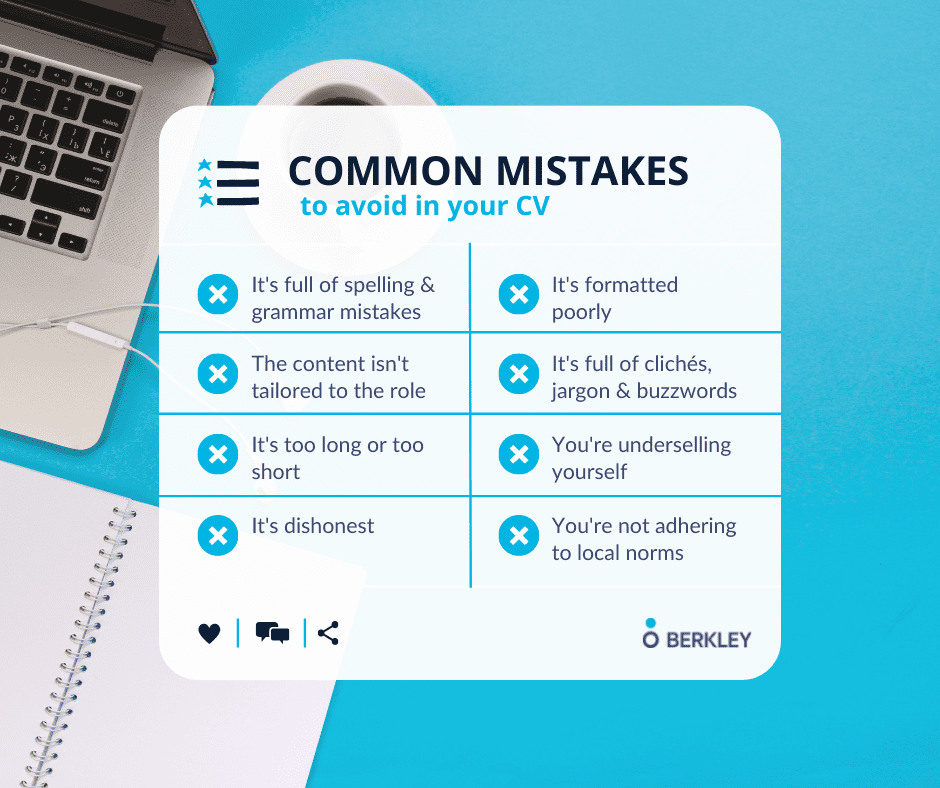
One question we frequently receive from job-seekers is, “why is my CV not getting any interviews?” Our consultants sift through countless CVs every day and have identified the ten most common mistakes that are preventing candidates from progressing to the job interview stage.
Why Is My CV Not Getting Any Interviews?
- Your CV Is Poorly-Written
- Your CV Isn’t Tailored To The Role
- Your CV Isn’t the Right Length
- Your CV is Full of Fibs
- Your CV is Formatted Poorly
- Your CV Relies Heavily on Clichés, Jargon & Buzzwords
- You’re Underselling Yourself
- You Don’t Understand Local Norms
- Top CV Tips from Berkley’s Recruitment Consultants
Your CV Is Poorly-Written
According to Undercover Recruiter, 59% of recruiters reject a CV because of poor spelling and grammar. Yet, one study from Grammarly found that a typical CV has an average of five potential errors. From a recruiter’s point of view, a badly written CV immediately discredits the candidate as it indicates sloppiness and inattention to detail. To avoid this, you just need to take the time to proof your CV thoroughly.
How to Proof Your CV
- When composing your CV, install a spellchecker such as Grammarly to catch any obvious errors.
- Once you have completed your first draft, print it out and read it three times.
- Make the necessary corrections and print the document out again.
- Wait a day and then read the document starting from the end and working backwards.
- Ask a trusted friend or your recruitment consultant to review the document.
Your CV Isn’t Tailored To The Role

“A job spec is the ‘wish list’ for a hiring manager. If you have specific experience that matches a job spec, ensure you’re adding that detail so it jumps out to someone reading your CV – spending that extra five minutes including relevant experience will help you to secure that first-round interview.”
Another reason why your CV isn’t getting any interviews may be that you are not customising it for every application. Many job-seekers make the mistake of sending a generic CV to multiple organisations. Yet, research tells us that 63% of recruiters want to receive CVs that have been tailored to the position. Evidence reveals that to give yourself the best chance of landing a job interview, you should aim to write a customised CV that “connects the dots” between your qualifications and the requirements of the role.
Your CV should clearly communicate the reasons why you would be the best fit for the job. You can do this by highlighting how your skills and experience could add value to the role and the organisation. This greatly cuts down work for the hiring manager and will distinguish you from the other candidates.
If you are working with a recruiter in your job search, we advise asking them for advice on how to tailor your CV to each role you apply for. Given their relationship with the client, they are in a good position to advise you on what to include to make your CV more attractive to prospective employers.
Your CV Isn’t the Right Length
When a recruiter or hiring manager is flooded with applications, they can only afford to give each CV so much attention. As such, getting the length right is key. For candidates, this means communicating key points of information in a clear and efficient manner so the reader can quickly and easily pick out the most relevant information.
How Long Should My CV Be?
| Candidates with <1 year experience | 1 page |
| Candidates with 1-7 years experience | 2 pages |
| Director-level candidates with 7+ years experience | 3 pages |
| Experienced freelancers & contractors | 3 pages |
How to Shorten A CV
- Only provide relevant information.
- Never use two words where one will do.
- Omit personal pronouns.
- Cut out any superfluous or repeated points.
- Expand on the three most recent/relevant roles and then just list the rest.
- Use your cover letter to convey any information you couldn’t fit into your CV.
- Use your cover letter to contextualise your accomplishments.
Your CV is Full of Fibs
In a 2014 study of 1,000 Irish workers, four-fifths of respondents admitted to lying on their CV. Some of the most common falsehoods include:
- Exaggerating education and qualifications
- Stretching the length of time spent in a job
- Exaggerating level of expertise or experience
- Adding personal interests
- Changing a job title to sound more impressive
- Fake references
Lying on your CV can have serious consequences if you are caught. For one, it will completely rule out your chances of getting the job. What’s more, your professional reputation will be damaged. In very serious cases, it may even result in legal action for committing fraud.
These days, job-seekers who lie on their CV are very likely to be caught out. Years of experience and training means that seasoned recruiters and hiring managers can easily spot a lie. What’s more, many organisations have implemented rigorous screening processes that are very effective at identifying false information.
Your CV is Formatted Poorly
When it comes to CV, how you present the information is just as important as what you say. Remember that the person reading your CV will likely be reviewing many similar documents, so acing your formatting will not only make their job easier but it will also help you to stand out from the crowd. A good recruiter will advise you on how to format your CV in an appealing manner.
| CV Formatting Do’s | CV Formatting Don’ts |
|---|---|
| Include an attractive header with your name and contact details | Use a font size of less than 12 |
| Use headings above each section | Use a hard-to-read font |
| Use bullet points | Be afraid of negative space |
| Use reverse-chronological order | Use a margin of less than 1 inch |
Your CV Relies Heavily on Clichés, Jargon & Buzzwords
A Cliché is a word or phrase that is “overused and betrays a lack of original thought”.
A Buzzword is “a word or phrase, often an item of jargon, that is fashionable at a particular time or in a particular context.”
Jargon describes “special words or expressions used by a profession or group that are difficult for others to understand.”
(Source: Oxford Languages)
When writing your CV, you need to remember that the end-reader will likely read many other CVs in addition to your own. As such, it’s worth investing your time and effort into crafting an original application that will stand out from the competition. One way you can do this is by avoiding clichés, jargon and buzzwords. The overuse of these phrases will undermine your application by revealing a lack of imagination and laziness.
In a 2018 study of over 1.1 million CVs from the UK, Adzuna identified the top ten most overused terms:
| 1. Motivated | 6. Leader |
| 2. Initiative | 7. Experienced |
| 3. Social | 8. Hardworking |
| 4. Organised | 9. Outgoing |
| 5. Friendly | 10. Driven |
To write a stand-out CV that is wholly unique, put effort into finding creative and persuasive ways to communicate why you are a good fit for the role. Mirror the language used in the original job description. Instead of saying you have certain skills and qualities, outline times when you successfully applied these in previous roles and support your claims with data.
You’re Underselling Yourself
One of the top reasons why your CV might not be getting any interviews is because you’re underselling yourself. Your CV is essentially a sales pitch that you give to a potential employer. Yet, many applicants fail to effectively sell themselves on paper. In addition to outlining your professional experience and qualifications for the role, your CV must also persuade the hiring manager why these qualities make you an ideal fit for the job. While many people find the task of advertising themselves to be distasteful, it is a must if you want to succeed in today’s job market.
So what tricks can you use in your CV to sell yourself to an employer:
- Use powerful, persuasive action verbs e.g. spearheaded, exceeded, delivered, advocated, initiated. See here for a more comprehensive list.
- Rather than simply listing your responsibilities at a job, give examples of how you added value through your work.
- Remove any vague language and replace it with precise data or additional context. For example, you could switch out “Increased annual sales performance” with “Increased year-on-year sales performance by 25%.”
- Use a “before/after” framework is to tell a story about your achievements. For example, “The dated CRM system was failing to meet the needs of the sales representatives. I spearheaded the implementation of a major systems upgrade that resulted in increased efficiency and improved reporting. ”
You Don’t Understand Local Norms
If you are applying for a job abroad, you should research the different cultural expectations when it comes to CVs. There are some things that you will always need to include in your CV no matter where you are applying. These include your name and contact details, your qualifications and skills and your work history. However, there are a number of CV elements that vary from country to country. These include:
- Whether the document is referred to as a CV or a resumé
- The length of the document
- Whether or not you need to include a photograph
- Whether you are expected to provide personal information, such as your gender, your date of birth, your marital status and number of children
You can learn more about CV norms and expectations in your chosen country by visiting online forums, tapping into your professional network, or by reaching out to a local recruitment consultant.
Top CV Tips from Berkley’s Recruitment Consultants
“The key to a good CV is keeping it clear. If you have a very busy CV, scale it back. Include the relevant detail, and reduce the content that’s very dated. Hiring managers will scan for the skills and experience they specifically need, so ensure you tailor your CV for each application to ensure you’re hitting all the key points in your CV.”

I would say the most common downfall is that candidates are not confident enough when attempting to relay their achievements and competencies. It’s not a bad thing to big yourself up on your CV… if you are capable and have the talent, do not be afraid to show it. Confidence, both on and off paper, is key. Own it.

Use bullet points under your responsibilities to make your CV easier on the reader’s eye.
Need More CV Help?
We’ve got you covered with our interview-winning CV templates! Compiled by Berkley’s in-house recruitment experts, these top-quality templates are an ideal place to source inspiration for your next CV. To get started, simply click to download a Word Document file and customise it with your own edits.
Is your CV up to snuff? Contact Berkley today to arrange a free consultation where our in-house experts can review your CV to see why it isn’t getting any interviews and offer tips on how to improve your CV.