Pensions for Contractors
Much like mortgages, pensions can be a source of confusion for contractors. Read our guide to learn more about pensions for contractors.
What is a Pension?
A pension is a long-term savings plan which allows you to build up a fund for retirement. Unlike other forms of savings, many pensions offer excellent tax incentives.
What Are the Different Types of Pensions?
- Occupational Pensions: These schemes are set up by employers to provide pensions for their employees.
- PRSA/ Personal Pensions: This is a retirement savings plan in which you make contributions on a regular basis and/or as a once-off lump sum.
- State Pension: This is a regular payment from the Government that most people can claim upon reaching the age of 66.

Why Do You Need A Pension?
Maintain a High Standard of Living
A well-funded pension compensates for the reduction of income that most of us will experience in retirement. Irish people who turned 65 in 2020 will, on average, live 50% longer than people who reached that age in 1970. As a result of our longer lifespans, most of us can now look forward to 20-30 years of retirement. While there is a good chance that you will be eligible for the State Pension, you will more than likely need to supplement this with additional retirement funds as it currently pays less than the average industrial wage.
Tax-Efficient Savings
Pension contributions provide a means of paying less income tax as you can avail of tax relief on contributions. Up to Revenue Limits, personal contributions to a pension qualify for relief from income tax. This means that, where the higher rate of income tax is 40% and you are a higher rate taxpayer, a €100 contribution to a pension will only have a net cost to you of €60 (had you not made the contribution, the other €40 would have gone to the government as income tax).
The Government provides tax relief on contributions made to pension schemes at your highest marginal rate. Gross roll-up applies to pension funds which means that unlike other savings and investments, the gains made in a pension investment are allowed to grow tax-free. This means that more of your money is invested for more of the time.
On maturity, you can avail of a tax-free lump sum. Company/occupational pensions offer an excellent means for companies to extract profits in a tax-efficient manner. The rest of the benefit, may be taken in the form of an Approved Retirement Fund (ARF), as a taxable lump sum or as an annuity (a guaranteed income for life).
Protection to Dependents on Your Death
One key benefit of pensions is that they allow you to make financial provision for dependants and beneficiaries in the event of your death. Depending on the type of pension that you go for, your dependents may be eligible to receive protection in the form of a lump sum or pensions.

How Much Do You Need for Retirement?
As a general rule, you will need about 50% of your gross pre-retirement income to make an adequate gross retirement income. According to data from Aviva, a whopping 60% of 35-54-year olds have inadequate retirement funds. To learn more about how much you will need for your retirement, why not try this handy Pensions Calculator tool from the Pensions Authority.
Pension Options for Contractors
Whether a contractor operates under an umbrella company or a through a private limited company will determine the most tax-efficient pension for them. Contractors operating under an umbrella company should opt for a Personal Retirement Savings Account (PRSA) rather than a Personal Pension Plan (RAC). PRSAs offer greater flexibility and portability. Transferring your PRSA into a company pension plan, should you decide to switch to PAYE employment or establish a Personal Limited Company at a later date, is a relatively straightforward process as opposed to transferring a Personal Pension Plan.
Contractors who have set up a Personal Limited Company structure should set up an Executive Pension Plan (EPP). Employer contributions to EPP’s are subject to considerably higher limits than personal pensions. These limits are based on your earnings, service and the level of fund you have built up to date. A contractor may use an EPP to avail of ‘Wealth Extraction’. In simple terms, this involves the company transferring money into the contractor’s estate tax-free using an Executive Pension Policy (EPP). Just like personal pensions, the funds invested in an EPP are allowed by Revenue to grow tax-free. EPP’s may also be used as a tax-efficient means of transferring wealth between generations.
Starting a Pension makes sense on many levels. However, pensions can be complicated, so it also makes sense to get advice. For more information, talk to your local pensions advisor.
Why Start Your Pension Today?
When it comes to pensions, it’s best to start one as early as you possibly can. Research shows us that for every ten years that you put off saving, you double the cost of how much you need to put away to get to the same place when you retire. Ideally, you should pay as much as you can afford consistently. Even if you invest small amounts to start with, these will grow over time and become very large by the time you retire. When it comes to pension contributions, a good rule of thumb for contributions is to refer to the Revenue’s guidelines. For example, those aged under 30 might want to contribute 10-15% of their income.
Have a Question about Contractor Pensions? Sign Up for Our Webinar!
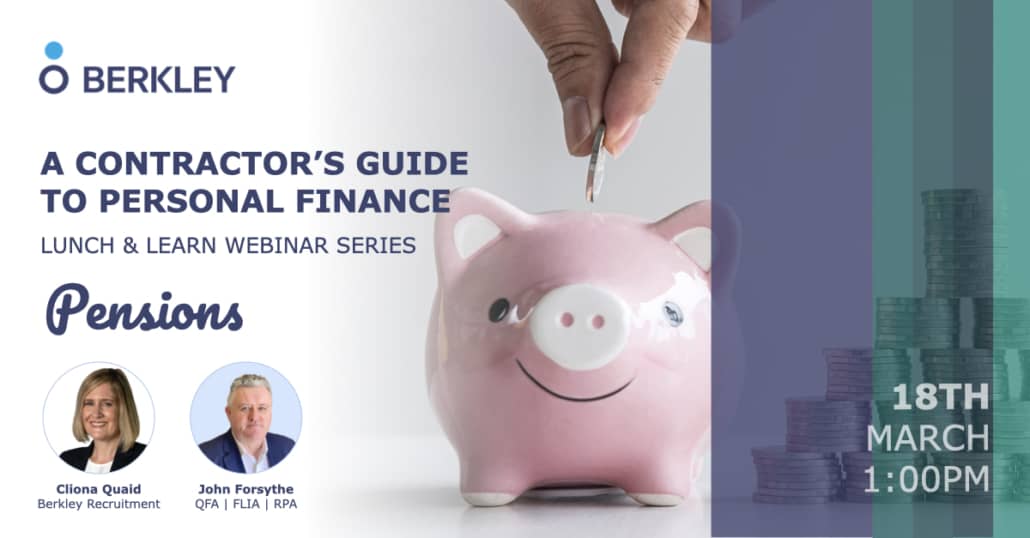
Berkley Recruitment is thrilled to announce the launch of a new webinar series entitled, “A Contractor’s Guide to Personal Finance.” This two-part series aims to address common questions that contractors have about personal finance matters. Taking place on the 24th of February, the first webinar will focus on the subject of pension options for contractors. We will be joined on the day by Financial Advisor and Pensions Expert, John Forsythe.