Representation of Women in Ireland’s STEM Sector
To mark International Women in Engineering Day 2021, we are looking at the state of female representation in STEM in Ireland today.
But First, What is STEM?
Coined in the 1990s, STEM is an acronym that stands for “Science, Technology, Engineering & Mathematics”. This term encompasses a diverse range of educational and industrial disciplines.
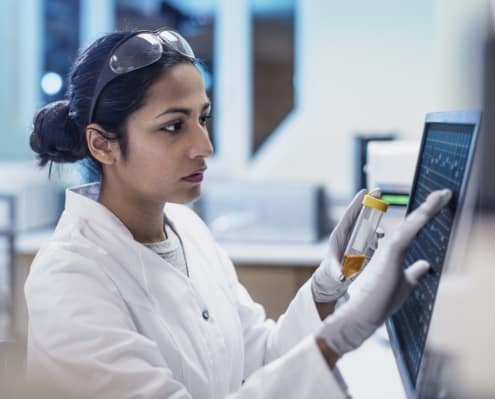
The Rising Demand for STEM Professionals
New technologies have disrupted the labour market significantly through the creation of new roles, the displacement of manual roles through automation, and the transformation of existing jobs. This has led to an increase in demand for candidates with STEM skill-sets. The European Centre for the Development of Vocational Training writes:
“Demand for STEM professionals and associate professionals is expected to grow by around 8% between now and 2025, much higher than the average 3% growth forecast for all occupations. Employment in STEM-related sectors is also expected to rise by around 6.5% between now and 2025.”
The Importance of STEM in Ireland
The STEM sector is key to Ireland’s success and is likely to grow in importance over the coming decades. According to the 2015 Action Plan for Jobs, Ireland is currently home to:
- 9 out of the top 10 global software companies
- 3 out of the top 5 US games publishers
- All 10 out of the top 10 ‘born on the internet’ companies
- 15 of the top 20 medical technologies companies
- 9 out of the top 10 pharmaceutical companies
As such, Irish candidates with valuable STEM qualifications and capabilities are highly sought after and can command impressive salaries. Yet, the 2015 Vacancy Overview revealed that the largest growth in vacancies occurred in the Information and Communications sector and the Professional, Scientific and Technical sector showing the third-highest increase.
The Current State of Female Underrepresentation in STEM in Ireland
While Irish men and women are as likely to pursue science careers, there is a clear imbalance in the areas of technology, engineering and mathematics. Studies produced over the years about the gender disparities within STEM have created the metaphor of the “leaky pipeline”. This describes the points at which girls and women leave STEM – childhood, secondary school, university, postgraduate studies, STEM professions, and STEM leadership positions.
Education
While there is a general upswing in the number of students choosing STEM subjects on their CAO applications, uptake among girls remains low. Figures from a UCD Study reveal that over 40% of boys list a STEM course versus just 19% of girls.
Unsurprisingly, the trend continues into academia. Statistics from the European University Institute show that while half of the academic staff at lecturer-level are female, women comprise a mere 19% of full professorships. WITS Ireland writes “Since only 1 in 6 engineering graduates is a woman, the numbers of female engineering professors are even worse.”
Industry
Currently, there are approximately 117,800 people across Ireland who are working in jobs that require STEM skills. However, the CSO reports that just 25% of these roles are performed by women. There is also a “marked under-representation” of women occupying senior-level positions across the various STEM sectors (“This is why more girls need to take up STEM subjects in school”).
Why is this an Issue?
“Every girl deserves to take part in creating the technology that will change our world and change who runs it.”
~ Malala Yousefzai, Women’s Education Champion & Nobel Peace Prize Recipient
Due to the emergence of digital technologies and other important innovations over previous decades, the power to change the world and shape the future arguably lies increasingly within the STEM sector.
As the STEM sector continues to grow in importance, it is women who are likely to be left behind due to the long-standing gender gap across both STEM education and industry. This is a particularly pertinent issue for Ireland – a country whose economic future hinges on the positioning of itself as a “global innovation leader”. This strategy is contingent on the development of a sustainable talent pipeline of young STEM professionals – something that will not be possible without the involvement of women.
A report issued by the World Economic Forum last month showed that as technology continues to replace human activity, and STEM careers grow, it is women who will be most affected because of their low participation in STEM professions. ‘Women stand to gain only one new STEM job for every 20 lost across other job families, whereas the ratio for men is one new job for every four lost elsewhere’ (“‘There’s an image problem’: the drive to attract girls to STEM”).
What are the Barriers?
Lack of Role Models
A lack of role models is often cited as a contributing factor to low female participation in STEM. Research from PwC shows that 4 out of 5 university students in the UK can’t name a single woman working in tech today. What’s more, analysis from See Jane found that men made up 62.9% of STEM characters in film, television, and streaming content versus just 37.1% of women.
Access to positive role models from a young age can help to “broaden the perspectives of who can work in the STEM field, they also expand students’ perceptions of their own potential” (“Girls in STEM: Is It a Female Role-Model Thing?”) Interaction with positive role models can be hugely effective in breaking stereotypes and give girls the confidence they need to pursue a career in STEM.
Bias & Stereotyping
From a young age, girls are exposed to negative gender stereotypes around STEM. These stereotypes may be reinforced through the media (e.g. underrepresentation of women in STEM roles on TV), education (e.g. no provision of physics classes in secondary school), or through conversations with influential adults (e.g. family members, teachers etc.).
The most common stereotype around STEM is that it is more suited to boys’ skillsets. While extensive research has disproved this, many girls today are still deterred from STEM studies as they believe it to be too difficult and that they won’t fit into this “boy’s club”.
Work Environment
Upon entering the workforce, there are still a number of factors that contribute to women leaving STEM careers. These include the pay gap, lack of career advancement, and work/life balance.

Why We Need More Women in STEM in Ireland and Around the World
Research shows us that having a more diverse workforce makes for better business. There is a wide range of benefits associated with greater gender diversity including:
- A variety of different perspectives
- Increased creativity
- Better decision-making
- Greater innovation
What’s more, data reveals that boosting the number of women in STEM can equate to an additional $12 trillion in the global GMP by the year 2025.