Understanding Counter-Offers: A Guide for Job Seekers
In today’s job seeker’s market, employers are under pressure to retain high-quality team members. As such, we are seeing more and more employers make counter-offers to employees upon learning of their plans to move on. Read our latest blog for a comprehensive guide on counter-offers and how to respond to them.
Table of Contents
- What is a Counter-Offer?
- Counter-Offer Statistics
- The Top Reasons Why Employers Make Counter Offers
- Reasons Why You May Accept A Counter-Offer
- Reasons Why You May Decline A Counter-Offer
- The Potential Downsides of Accepting a Counter-Offer
- 10 Questions to Ask Yourself Before Responding to A Counter-Offer
- Talk it Over With Your Recruiter
- Counter-Offer Etiquette
- Key Takeaways
What is a Counter-Offer?
When an employee resigns from their job, their employer may make a counter-offer to induce them to stay. Employers typically make a counter-offer within a week or less of receiving the employee’s notice. Counter-offers can take many forms including one or more of the below:
- Increased salary
- Additional company benefits
- A promotion
- A change in role
- Added responsibilities
- Additional job flexibility
- More involvement in projects that interest you
- Promises or future considerations
Counter-offers are particularly prevalent in candidate-driven markets such as Tech, Supply Chain and Engineering, where skills shortages make it hard to source and recruit new employees.
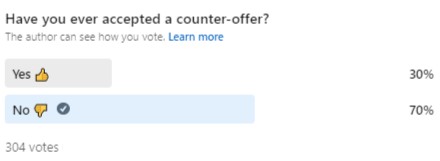
Statistics About Counter-Offers
- 50% of candidates that resign will be counter-offered by their current employer. (Source: UK Recruiter)
- 38% of hiring managers reported not making counter-offers at all. (Source: Recruiter Box)
- 57% of employees accept counter offers made to them. (Source: Recruiter Box)
The Top Reasons Why Employers Make Counter Offers
- To retain the employee’s valuable knowledge of the company.
- The employee has a niche skill-set that will be hard to replace.
- To save on the costs of hiring and onboarding a replacement.
- To avoid increasing the workload for the rest of the team.
- To keep up staff morale and team relationships.
- They do not have enough time to recruit and onboard a new employee.
- They want the employee to complete a time-sensitive project.
- They want to buy time until they can find a replacement.

Reasons Why You May Accept A Counter-Offer
There are some cases when accepting your employer’s counter-offer is the right call.
You may wish to stay with your current employer if you are having second thoughts about the new job offer. If it is the case that you still want to change jobs but are having doubts about the recent offer, then your best bet could be to accept the counter-offer and keep job-hunting until you find a role that’s right for you. You may want to consider partnering with a recruiter to ensure that the next offer you receive is the best fit for you.
Candidates who are purely motivated by money may also be more inclined to accept a counter-offer. However, before making a decision, you will need to weigh up whether this short-term monetary gain is more important to you than your long-term career goals.
Reasons Why You May Decline A Counter-Offer

“Are counter offers just a last-ditch attempt to show a company really cares? Or are they a panicked reaction to keep staff who they cannot afford to lose? Why wasn’t the employee been rewarded with these increases/improvements before saying they are leaving?
The real question is, will the counter-offer fix the issues that prompted you to leave in the first place? Chances are it may not! The primary reasons employees resign are lack of career opportunities, over-looked on promotion, salary not being in line with the market, negative work culture etc.
The majority of people who accept a counter-offer still leave their employer. This goes to show that most counter-offers only fix a financial aspect rather than addressing the bigger picture and these issues tend to come to the forefront again very quickly”.
In most cases, it won’t be in your best interest to accept a counter-offer. By the time an employer makes a counter-offer, they know that your loyalty to the company is in question. While accepting a counter-offer may initially meet your short-term needs, ultimately this move could hamper your future career progression within the company. For example, your employer will be far less likely to offer you a promotion as they are aware that you could leave the company as soon as a better job offer comes along.
What’s more, while the prospect of a salary bump seems very attractive, it’s worth acknowledging that money can’t solve everything. Ask yourself if the extra income will make up for the problems that made you want to leave in the first place. Realistically, these problems will persist even after you accept the counter-offer and you may end up handing in your resignation anyway.
The Potential Downsides of Accepting a Counter-Offer
According to data from Phaidon International, a whopping 80% of candidates who accept a counter-offer from their current employer end up leaving within six months. What’s more, a study from Heidrick & Struggles has revealed that almost 40% of senior executives and HR leaders alike agree that accepting a counteroffer from a current employer will adversely affect one’s career.

“Candidates under counter-offer need to consider why they wanted to move on from their role in the first place. If it’s purely money motivated, then speaking to your manager may be the easiest solution. If it’s more than salary, then it’s unlikely that much will change to warrant you staying in your role.
Counter-offers really highlight what someone ‘should have been’ earning before they attempted to make a move. It’s a shame that most need to tell their employer they’re leaving before they get their value in their role.”
Studies show that most candidates that accept a counter-offer will be active on the market again in six months, so ask yourself, will you really be happy in six months, or will you wish you made the move?”
10 Questions to Ask Yourself Before Responding to A Counter-Offer
- What would be your dream job?
- What do you value in a job (e.g. money, challenge, clear track for career progression, work-life balance, flexibility etc.)?
- Where do you want to be in a few years time?
- What are your long-term career goals?
- What does your career need next to bring you closer to meeting your medium-long term goals?
- Is your current boss aware of your career goals and are they supporting your career progression?
- What will change if you accept the counter-offer?
- Does the counter-offer address the reasons you wanted to leave in the first place?
- Would a pay increase provide enough compensation to make you overlook the things that made you want to leave?
- What would you gain if you leave?
Can’t Decide? Talk it Over With Your Recruiter
One of the benefits of working with a recruitment partner is that you can use them as a sounding board. If you have been given a counter-offer and are unsure how to respond, discuss the pros and cons of both options with your recruiter. They will be able to advise you on the best move for your personal and professional growth.

Counter-Offer Etiquette
When it comes to responding to counter-offers, honesty is the best policy. You should never lie about a fictitious job offer to prompt a salary raise from your employer. Conversely, don’t make up a counter-offer when negotiating salary with a potential new employer. Lying could backfire spectacularly and may result in serious reputational damage or worse. If you want to secure a good deal with a new employer, then your best bet is to partner with a seasoned recruitment consultant who can negotiate a deal that will satisfy both parties.
Another important point is timing. Coming at the situation in the right order shows proper consideration for all involved parties. In an ideal world, the best time to approach your employer about career moves is before you start applying for other roles. If you have a good relationship with your manager, schedule a one-to-one meeting during which you can discuss your career. This will give you an opportunity to bring up any issues you are facing. It will also give you key insights as to where you stand with the company and whether it is in your best interest to stay there.
Otherwise, the best time to talk to your manager is after you are approached with a job offer from another company but before you have responded to it. If you are interested to hear what your employer comes back with, then having a firm offer in place will give you strong leverage.
Do not wait until after you have accepted the other company’s offer before talking to your manager. Accepting a counter-offer after already accepting the original offer could damage your professional reputation and relationships as it reveals a willingness to burn bridges.
How to Accept a Counter-Offer
If you have decided to accept your employer’s counter-offer, then you will need to communicate in a clear and timely manner to both parties. When informing your recruiter and the other organisation of your decision, express thanks for all of the time and effort that went into the recruitment process and state that you have decided not to accept the job. They may follow up with you to learn more about the reasoning behind your decision.
How to Decline a Counter-Offer
If you have decided to reject a counter-offer, it is important to be tactful so as not to burn any bridges. You want to strike the right balance between being firm and being polite. Start by thanking your employer for the offer and express appreciation for the fact that they wanted to keep you on. Give some indication as to why you have decided to reject the offer, but keep your tone positive. Restate your final day and offer to help with the transition during your notice period.
Key Takeaways
While receiving a counter-offer from your employer may feel flattering, in most cases, it is ultimately in your best interest to decline the offer as it is likely to hold you back from achieving your long-term career goals. However, whether you decide to accept or decline the offer, it’s important to be tactful and keep the lines of communication open with all parties. If you need help making your decision, discuss your options with your recruitment consultant.