In this guide, we will show you how to plan your next career move. We will demonstrate the importance of career planning and show you how to find a role that supports your long-term career goals.
Career Planning – The Key to Professional Success
Successful careers don’t just happen. They take years of hard graft, constant learning and strategic planning. Forward-thinking and strategic planning are essential in order to ensure that you are continuously progressing in your career. Yet oftentimes, candidates go out on the job hunt without considering how their next role will impact their overall career arc. This is an all too common mistake that leads to many talented professionals finding themselves stuck in a career rut.
Career planning is a tool that allows you to proactively manage your professional life. By undertaking career planning activities, you can explore and define your goals, identify key tasks and roadblocks, and create a roadmap. This will give you greater focus and motivation in your career journey as you pursue your professional goals.
A recruitment consultant can be a useful ally throughout your career. They can advise you on market opportunities and recommend next steps to ensure constant improvement and progression.

How to Plan Your Next Career Move
Table of Contents
Step 1: Think About Your Career Development Plan
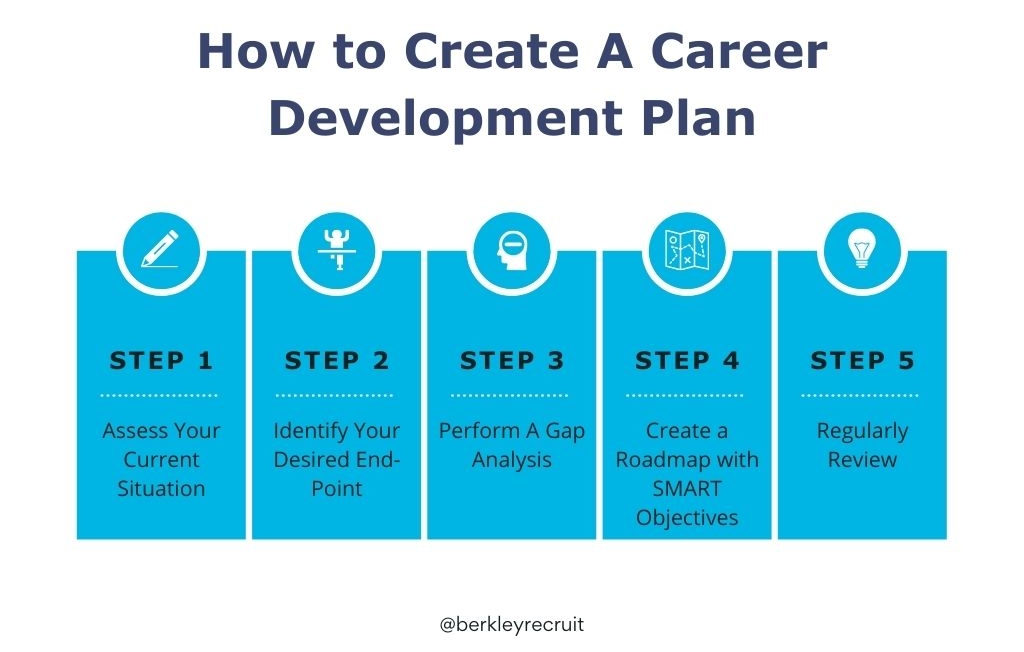
To help kickstart your career plan, we at Berkley have devised a handy Career Development Workbook that you can complete virtually or by hand. This document makes the career planning process easier by breaking it down into very manageable bitesize chunks. Our workbook walks you through the stages of self-assessment, goal-setting, gap analysis and the formation of SMART career objectives. Once you have completed this workbook, you will have a much clearer idea of what success means to you. This knowledge will allow you to figure out how to plan your next career move in a strategic way.
Step 2: Get Feedback
While self-reflection is important, it is also a good idea to consult other people. In doing this, you will benefit from an outside perspective and gain new insights. To get as much feedback as possible talk to a range of friends, family, colleagues, mentors and managers. Alternatively, you can seek external counsel from a specialist recruitment consultant or a career coach.
Some questions you could ask include:
- What do you think are my biggest strengths and weaknesses?
- How would you describe my personality?
- Do you think this path would be a good fit for me?

Step 3: Go Window-Shopping
In this case, the term “window shopping” refers to the act of browsing current open roles without intending to apply. Regularly check jobs websites for new roles and read the job descriptions carefully. Note down any trending skills that are frequently mentioned. You can use this list to identify any in-demand skills that you may need need to upskill on. You can focus on bringing your skills and knowledge up-to-date until you are ready to make your next career move. Why not start window shopping now by browsing Berkley’s Jobs Portal?
Alternatively, you can call up a trusted recruitment partner and ask them to walk you through the current market. They can outline where employer demand is in terms of skills, qualifications and experience. They can review your CV and highlight your key strengths and selling points in the context of the current employment market.
Step 4: Don’t Rule Out Lateral Moves
A Lateral Career Move refers to when you change to a new role that is at the same level as your previous position. This may involve moving to a different department in your current company or taking on an entirely new role with a different company.
Lateral moves are the opposite of vertical moves i.e. where you climb the career ladder in search of new titles, higher status and a larger income. Lateral moves are often viewed negatively due to the misconception that they don’t help you advance your career.
However, there are many benefits to making a lateral career move. Firstly, it allows you to diversify your skill-set and gain new experiences. This prevents you from becoming pigeonholed into one career path and can make you more marketable in the long run. What’s more, making a lateral career move (whether it’s internally within the same company or externally to a new company) also allows you to expand your professional network.
Step 5: Be Your Own Cheerleader
Self-advocacy refers to the ability to effectively communicate and assert your own wants, needs, interests and rights at work. Effective self-advocacy can help “make your work experience the best it can be and to move your career forward” (Source: Goodwill). Some examples of self-advocacy at work include:
- Speaking up for what you want
- Demonstrating how your work adds value to the organisation
- Showing pride in your work
- Not downplaying your accomplishments
- Not being afraid to leave and find a role where you’re valued
As we grow up, many of us are taught to avoid appearing braggy or arrogant. However, learning how to effectively advocate for yourself in the workplace is essential if you want to get ahead. One way you can learn to communicate your wins is to keep a “Brag Book” i.e. a folder/document where you keep a record of your achievements. Keeping a record of your wins will give you the confidence boost you need to share your successes with others.
Step 6: Interview Smarter
When you start interviewing around for your next career move, it’s in your best interest to take a strategic approach. Before each interview, take some time to reflect on the following:
- What are your motivations for leaving your current job?
- What do you value in a workplace?
- What are your long-term career goals?
- What do you need in your next job to bring you closer to achieving your long-term career goals?
To help ensure that you get relevant information that will help you to assess the role, write down a list of questions pertaining to the points above. We also recommend that you read our dedicated Job Interview Guide for more interviewing strategies and advice.
If you have partnered with a recruitment consultant, they can perform mock interviews with you. What’s more, they can offer you advice on what specific qualities the employer in question is looking for.
Example
Grace is a mid-level Software Developer with a small team in Cork.
Having thought about her career plan, she has set a long-term goal of becoming a Manager. In order to develop her management skills, she will need to find opportunities to spearhead new projects. However, her current boss is a Micromanager and it is unlikely that she will receive the autonomy and trust required to take ownership of new projects.
She has decided that the time has come to find a new job. Grace’s top priorities are to find a company that fosters employee growth through the provision of upskilling opportunities and by actively promoting a culture of trust and innovation.
Some of the questions she plans to ask in her interviews include:
- In what ways does this company support its employees?
- Are there opportunities for this position to change or expand?
- How can I get support in setting goals and expectations?
- How will working in this position grow my skills?
- How have successful employees advanced in this company?
- Does the company offer any incentives for learning new skills?
Step 7: Don’t Rush into Accepting A Job Offer
Do not just accept a job offer simply because it’s offered to you. The decision to switch jobs can be a life-changing decision and is not something that should be rushed into.
If an employer makes you a job offer, it’s polite to respond with an acknowledgement that you have received the offer. Ask the employer how much time you have to make a decision and let them know that you will be in touch soon with a final response. Large, multinational companies have slow-moving hiring processes and are likely to give you plenty of time to respond, however, SMEs will likely need a response within the week.
If you are working with a recruitment consultant, they will manage the offer negotiation on your behalf. A good recruiter is a skilled and experienced negotiator and can use their knowledge and relationship with the client/employer to secure the best deal for both client and candidate.
When assessing a job offer, you will first need to gather as much information as possible about the role and the company. In the rush to give a definitive answer it can be easy to lose sight of your career goals, but it’s important to carefully consider where this role could potentially sit within your longer-term career plan.
Rather than thinking in generalities, i.e. “This role could let me learn, grow and develop my skills”, be more specific and deliberate in your assessment of the offer “This role offers opportunities to learn X and gain experience in Y. This will ultimately help me to attain my dream job – position Z.”
Step 8: Consider Contracting
What is Contracting?
Contracting refers to when a skilled professional provides their skills to a client organisation. The contractor will provide these services for a pre-agreed length of time. Contractors are independent, in other words, they are not employees of the organisation. Rather they are self-employed through their own limited company or they utilise the services of a specialist tax accountancy firm.
Making the switch from permanent work to contracting can be a great way to boost your career. Many professionals who are used to working in permanent roles often discount contract roles due to misconceptions of instability, but the reality is that more and more employers are moving towards contingent, project-based workforce models. With every year, we are seeing an increasing number of contracting opportunities arise as organisations adopt this approach.
So, what are the main benefits of becoming a contractor?
- Contractors tend to enjoy a higher take-home pay than their permanent counterparts
- Moving from project to project will allow you to build a wealth of experience through continuous upskilling.
- You will have the opportunity to develop relationships across a range of different organisations.
- Contractors are their own bosses and have greater freedom and control over when and how they work
To learn more about making the transition from permanent to contracting and what this move could mean to you, you should arrange to speak with a Recruitment Consultant who specialises in contract roles. Here at Berkley, we have expert contracts teams covering a range of sectors including business, technology, life science, engineering, supply chain and procurement.
Key Takeaways: How to Plan Your Next Career Move
When it comes to building a successful career, it’s important to define what success means to you and to plan your career moves in a way that brings you closer to your ultimate goals. By applying the tips above, you will be able to plan and evaluate career moves in a smart and strategic way. If you want more advice on how to plan your next career move, why not book a free consultation with one of Berkley’s seasoned Recruitment Consultants?