Need to prepare for an important job interview? Scroll down to the infographic below to read our ultimate job interview checklist.
The job interview is probably the most critical step of the job search journey. It will give you an opportunity to show the hiring manager that you’re the best person for their job. As Roy Keane once wisely said, “Fail to prepare, prepare to fail.” Investing the time to prepare for an interview in advance can be a big help in terms of securing a job offer. Thorough preparation will allow you to stand out from your rival candidates as your answers be more well-informed and in-line with the values of the interviewing organisation. What’s more, doing your homework is one of the best ways to help you feel more calm and confident before the big day.
Preparing for a job interview takes time and focus. In fact, one study reveals that job applicants spend up to seven hours researching the company before their interview. To help you get prepared, our consultants have created a handy checklist of pre-interview tips and tricks. This useful infographic guide will help you to stay organised and focused in the lead-up to your next job interview. It covers:
Getting ready for the interview
How to research the company
Tasks to complete the day before the interview
Tasks to complete right before the interview
How to prepare for a remote interview
Things to remember during the interview
Steps to take after the interview has taken place
Complete the steps below and show the interviewer that you’re the best candidate for the job.
Read our Job Interview Checklist
If you need more help in advance of your interview, why not request a free consultation with one of our experienced recruitment consultants.
You’ve submitted your CV and done the prep, now all that’s left is the interview. Read our guide to discover how to calm your nerves before a job interview.
No matter how well-prepared you are, nerves are a normal part of the job interview process. According to a survey from JDP, 93% of job candidates have experienced anxiety related to their interview. To stop your nerves from getting the best of you on the big day, read our guide for ten stress-busting techniques.
10 Ways to Calm Your Nerves Before A Job Interview
1. Be Prepared
“By failing to prepare, you are preparing to fail.” – Roy Keane
Investing plenty of time into preparation is the best way to build up your confidence before an interview. Before your interview, be sure to set aside time to do the following:
Have an in-depth discussion with your recruiter about the role and the company
Gather all required tech for remote interviews by phone or email
Prepare a quiet space for remote interviews
Don’t forget to schedule a chat with your recruiter before the interview. They will be able to give you useful information about the company as well as some insights into their hiring processes.
2. Focus on Your Breathing
Right before the interview, take a mindful moment so you can relax and achieve a clear state of mind. Breathing exercises and meditation are highly effective ways of keeping anxiety at bay. An article from the University of Michigan explains, “Deep breathing is one of the best ways to lower stress in the body. This is because when you breathe deeply, it sends a message to your brain to calm down and relax. The brain then sends this message to your body. Those things that happen when you are stressed, such as increased heart rate, fast breathing, and high blood pressure, all decrease as you breathe deeply to relax.” A 2011 review article in Health Science Journal compiled some of the top health benefits of deep breathing techniques, these included:
decreased fatigue
reduced anxiety
better stress management
3. Pump Yourself Up
According to data from JDP, 64% of candidates listen to music to get them into the right mindset before an interview. A 2014 study from Northwestern University revealed that participants who listened to high-powered, bass-heavy music showed improved performance during interviews. Just as an athlete will listen to an empowering tune to get pumped up for an event, you might listen to some motivational music for a pre-interview confidence boost.
4. Practice Visualisation
Visualisation is a technique used by many top athletes to give themselves a pre-game confidence boost. Tiger Woods, Muhammad Ali and Jack Nicklaus have all attributed part of their success to practising visualisation. Psychology Now explains the reason why visualisation works: “Mental imagery impacts many cognitive processes in the brain: motor control, attention, perception, planning, and memory. So the brain is getting trained for actual performance during visualization.” Set aside some time before your interview to visualise what a successful interview would look like.
To do this:
Lie down in a quiet space. Shut your eyes, and fully focus on your breathing.
Once you feel relaxed, imagine yourself entering the interviewer’s office. Think about the various colours, light, shadows and objects in the room. What does the interviewer sound like when they greet you?
As you settle in, imagine yourself smiling warmly and the interviewer is smiling back. Once the interview commences, visualise yourself confidently and successfully answering the interviewer’s questions.
Visualise what a successful outcome would look like. For example, at the end of the interview, you might imagine the interviewer say something like “You’re hired” or “Welcome to the team!”
Related Content: Our Top 10 Video Job Interview Tips
Put simply, self-talk is your internal monologue. Sometimes, self-talk can be positive, uplifting and encouraging. Other times, it can be distressing, pessimistic and demotivational. Before an important event like a job interview, it’s important to pay attention to this as it can have a huge effect on your mindset. Use positive self-talk to silence your inner-critic. Be kind to yourself and practice self-compassion. If a nasty thought creeps into your head, try to distract yourself or challenge the self-criticism by asking whether it’s even true.
“After a fast-paced game of squash or several laps in the pool, you’ll often find that you’ve forgotten the day’s irritations and concentrated only on your body’s movements… As you begin to regularly shed your daily tensions through movement and physical activity, you may find that this focus on a single task, and the resulting energy and optimism, can help you remain calm and clear in everything.” – Mayo Clinic
One great trick to help calm your nerves before an interview is to exercise. Not only does exercise help take your mind off the upcoming job interview, but it is also a proven stress-reliever and confidence-booster. Studies show that exercising reduces levels of stress hormones (e.g. cortisol and adrenaline) in the body and stimulates the release of feel-good chemicals. On the day of the interview, set yourself up for success by going for a brisk walk, a dip in the pool or a half-hour yoga session.
Studies show that maintaining good physical posture not only projects confidence but it can also help you to feel more confident in yourself. A 2009 study found that people who sit up straight were more likely to believe thoughts they wrote down while in that posture concerning whether they were qualified for a job. Before and during the interview, be sure to do a quick posture check:
Is your back straight?
Are your shoulders relaxed?
Is your chest lifted from the breastbone?
Are both your feet firmly resting on the floor?
8. Plan a Nice Treat
Sometimes distraction can be a useful tool. While preparing for your interview, you should also plan something to look forward to afterwards. This will give you something else to focus on so that you’re not wholly consumed by interview anxiety. Perhaps you could plan an activity you enjoy or arrange to meet a friend for a delicious lunch. A lot of hard work went into applying for the job and preparing for the interview, you have earned a reward!
9. Drink Tea Not Coffee
Be strategic in what you eat and drink on the day of the interview. Avoid coffee directly beforehand as this may leave you feeling jittery. For your pre-interview caffeine boost, try a calming cup of green tea instead. According to Healthline, “Many people report having more stable energy and being much more productive when they drink green tea, compared with coffee.”
Another effective way to calm your nerves before a job interview is to make a “Gratitude List”. According to the JDP survey, 6% of respondents said that they made a Gratitude List as part of their interview preparations. A gratitude list involves writing a list of good things that you appreciate in your life and/or career. This exercise can help to relieve stress and increase feelings of positivity. As the career coach, Katherine Street writes, “people with a greater sense of gratitude are less depressed and neurotic, and more agreeable and open — traits that are attractive to employers.”
How to Calm Your Nerves Before A Job Interview: Key Takeaways
It’s natural to experience anxiety throughout the job interview process. However, it is possible to learn how to calm your nerves before an interview through the right combination of preparation and self-care. It may also help to approach a recruiter who can prep you for the interview and advise you on job interview techniques so that you feel more relaxed ahead of the big day.
https://www.berkley-group.com/wp-content/uploads/2020/11/christina-wocintechchat-com-LQ1t-8Ms5PY-unsplash-scaled-e1606474939989.jpg400495Robert Hawkeshttps://www.berkley-group.com/wp-content/uploads/2026/05/Berkley-Group-Logo-2026.svgRobert Hawkes2020-11-30 07:00:552022-05-26 10:14:44How to Calm Your Nerves Before A Job Interview
Check out our guide below to find out why contracting and contingent labour represents the future of work in Ireland and around the world.
What Is A Contingent Worker?
Contingent Workers are those who provide services to an organisation but who are not on the payroll. This is an umbrella term that encompasses many types of workers including contractors, consultants, temps and advisers. Oftentimes, these people are brought in temporarily to address a specific project need.
You Might Also Like: The Rise of the Project Economy
Contingent labour is on the rise in Ireland. According to a 2018 ESRI report, contingent employment made up just 10% of the overall active workforce in Ireland between the years of 2011 and 2013. According to one study, 45% of Irish workers can now be categorised as contingent labour.
Why is Contingent Labour the Future of Work?
Prior to 2020, contingent workforces were trending upwards with many multinationals and large tech companies (such as Google and Facebook) leading the way. Contingent workforces are becoming increasingly mainstream, sectors that wouldn’t traditionally have used this model (e.g. engineers, accountants, architects) are now exploring this as an option.
The Impact of the Covid-19 Pandemic on Contingent Labour
The ongoing pandemic has accelerated uptake of contingent workforces with more and more organisations adopting this model. Research from Gartner has found that 32% of organisations are replacing full-time employees with contingent workers. So why is this?
In times of crisis, organisations need to be agile in order to weather the storm. Contingent workforce models can be easily scaled up or down. This gives organisations the flexibility they need in order to dynamically adapt to changing market conditions.
Cost savings have long been a key driver for companies adopting contingent models, and with the ongoing pandemic this has taken on even greater importance. Contingent models help to decrease costs by reducing the costs of hiring, payroll, and the management of employees. Download a copy of Berkley’s 2022 Contracting Rate Guides to benchmark rates today.
What are the Benefits of Growing Contingent Work for Candidates?
As our previous article about the benefits of contracting outlines, there are many reasons why workers may want to look into contingent work.
These days, workers are no longer seeking a job for life. Contingent work offers greater mobility to move between a variety of jobs, projects and organisations.
Contingent work gives candidates more control over when and how they work. This gives them greater freedom to take breaks if they want to travel, study or spend time with loved ones.
As an increasing number of organisations implement contingent models, job opportunities for contingent workers will continue to grow.
The mobile nature of contingent work means that contingent workers can quickly develop new skills.
Contact Berkey today to learn more about contingent workforce models
https://www.berkley-group.com/wp-content/uploads/2020/11/brooke-cagle-uHVRvDr7pg-unsplash-scaled-e1605090207661.jpg400495Robert Hawkeshttps://www.berkley-group.com/wp-content/uploads/2026/05/Berkley-Group-Logo-2026.svgRobert Hawkes2020-11-04 10:00:372022-03-11 14:23:08Why Contingent Labour is The Future of Work
Louise O’Neill is the Manager of Berkley’s Business & Technology Permanent Division with responsibility for software and infrastructure. In this interview, she tells us about her recruitment career journey.
Translating Skills Into Career Change Success
Louise took a non-traditional path into recruitment, having started her professional life as a translator. “During that time, I gained excellent exposure to project management, team management, and working within timeframes. All of these skills have really stood to me and are now essential for my day-to-day work here at Berkley.”
After three years, Louise took the brave step of stepping into the whole new world of recruitment. “I realised that translation wasn’t people-oriented enough for me and didn’t offer the daily variety that I needed.”
So what attracted her to a career in recruitment? “I carefully reflected on the different career paths that would suit my skills in project management and team management, but that would also give me more social interaction and a busier day-to-day routine.” Ultimately, it was a meeting with a recruiter friend that sealed the deal and Louise hasn’t looked back since.
Scaling the Ladder at Berkley
Four years on, and Louise’s passion for recruitment hasn’t faded. “I get great satisfaction from it. One of the most rewarding things about recruitment is that I get to help great people grow their careers and to be a part of that story.”
It’s clear from our conversation that Louise is passionate about her field and that continuous learning is a key part of that. She comments “I’ve learnt so much in my time here. I relish the opportunity to continue to develop my market expertise with a leading recruitment company in the Irish market.”
In her short time at Berkley so far, Louise has made a real impact and her recent promotion to Manager reflects this. “One of the great things about working at Berkley is that the opportunity to advance is just there for the taking. The support I get from Tony, Arthur, Paddy and the whole team makes it possible to really grow my professional career.”
What is the Secret to A Successful Client-Candidate Match?
When it comes to supporting clients by finding the right candidate for a role, Louise asserts that “A job spec is just the beginning.” For her, meaningful engagement is the key to finding a good match. “I like to start the process by having an in-depth conversation with the client. I must be able to understand the role, its position within the business and the right cultural fit so I can identify what they really want in an individual.” She explains, “It’s all about engagement for me. From experience, having two-way quality engagement from the onset lays the path for a streamlined recruitment process that delivers the right candidate and strengthens the employer brand.”
What Do Candidates Need to Know to Boost Their Chances of Success?
The “Engagement Factor”, as Louise dubs it, is usually the biggest indicator as to whether or not a candidate will be a good fit for the role. “If a candidate is engaged throughout the process, then that gives me all the information I need to assess if they will be a good cultural and technical fit for the client.” She emphasises that personality is paramount, “It’s important that the candidate seamlessly integrates with the team and aligns with the organisation’s work culture and values.”
Tech Job Trends in 2020
In tech alone, Ireland employs over 37,000 people. In 2018, the Expert Group for Future Skills Needs predicted a shortfall in ICT skills of up to 146,000 people by 2022. So, what has Louise identified as the biggest growth areas when it comes to career opportunities in tech?
“Pre-COVID, cybersecurity was one of the fastest-growing sectors in tech. Now with a mass transition to hybrid working models, there has been increased pressure in the sector,” she says. “Currently, 6,000 people are working in Ireland’s IT security industry, and experts say that this figure will double by the year 2030.” Given the dynamic nature of cybersecurity careers and the ever-changing cyber-threat landscape, she states that career opportunities in the sector are varied and widespread.
She also highlights the tremendous rise in demand for skilled developers and programmers, “Cork is a Software Development hub with many multinational and SME’s here. It’s no surprise that we have a number of roles open across Software Development with some key clients of ours”. Between the years 2011 and 2016, the number employed in software engineering in Ireland grew by 35%. This demand continues to grow with digital and cloud adoption.
What are Louise’s Interests Outside of Work?
Louise is a passionate advocate for animal welfare. She cares for not one but three dogs – a labrador, a shit-zhu and a rescue pup. Her family also spent many years breeding puppies for the Irish Guide Dogs. “You get so attached to them but the flip side is that they’re a lot of hard work”, she explains. “It’s really rewarding to know that these little guys are going to change lives and that we get to be a part of that story.”
Talk to Louise O’Neill about Opportunities in Tech Today!
https://www.berkley-group.com/wp-content/uploads/2020/10/Louise-e1607695882455.jpg300400Robert Hawkeshttps://www.berkley-group.com/wp-content/uploads/2026/05/Berkley-Group-Logo-2026.svgRobert Hawkes2020-10-20 14:13:012021-06-28 15:01:39Meet the Team: Louise O’Neill
While work-related stress is nothing new, the past few years have marked a watershed moment in the history of workplace mental health. As such, it’s important to take time to reflect on how these changes and challenges brought on by the “new normal” may be affecting our mental and emotional health. In this guide, we will share five tips that have been proven to promote positive mental health in the workplace.
According to data from the WHO, one in four people will suffer from mental health problems at some point in their lives. Given that the average person will spend 90,000 hours at work over a lifetime, it’s crucial to ensure that we develop healthy working habits. It is also key to ensure that the workplace provides a safe and supportive environment in which positive mental health is promoted – even when that workplace is located in our own homes.
How Has The COVID-19 Pandemic Affected Mental Health in the Workplace?
There is a wide variety of factors to consider when looking at how the ongoing COVID-19 pandemic has affected our mental health at work. The pandemic is triggering feelings of stress, anxiety and uncertainty for many workers. On top of this, the mass transition to remote working has brought about numerous new challenges for employees and employers alike. Against this backdrop, many people are now experiencing unprecedented levels of stress, while those with pre-existing mental health conditions are further challenged by the current climate. As a result, many organisations are now looking into ways of promoting positive mental health among their employees.
5 Ways to Mind Your Mental Health At Work
1. Take A Daily Lunch Break
A recent Liberty Games survey revealed that 41% of respondents are likely to work through their lunch breaks while working remotely. When we work from home, many feel pressured to be visibly productive throughout the day and experience feelings of guilt or anxiety around taking breaks. Taking a daily lunch break is beneficial for your mental health as it gives your mind a chance to rest, recharge and refocus. Lunch breaks have also been shown to boost productivity, concentration and creativity.
How to Get the Most Out of Your Lunch Break
Log off from your work phone and computer for the entirety of your break.
Step away from your workspace.
If the weather permits, go outside for some fresh air – get a walk in or go for a quick cycle.
Do a creative activity that you enjoy such as playing an instrument or working on a crafty project. Research from Drexel University reveals that just 45 minutes of creative activity is a highly effective way of reducing stress in the body, regardless of artistic experience or talent.
2. Meditation & Mindfulness
The Mayo Clinic describes meditation as an activity during which “you focus your attention and eliminate the stream of jumbled thoughts that may be crowding your mind and causing stress.” Research has linked meditation with numerous emotional benefits, including:
Developing resilience and stress management skills
Cultivating self-awareness
Learning how to focus on the present
Boosting imagination and creativity
Increasing patience and compassion
Increasing focus, energy and productivity
Practicing meditation at work may help you to cope with day-to-day stress and can be an effective way to ward off burnout. For example, when Aetnalaunched a meditation program across their organisation they found that participants’ stress levels dropped by 28%.
The more regularly you meditate, the more you will experience the benefits. So rather than only meditating in times of stress, it is more beneficial to work it into your daily routine. It’s a good idea to schedule a daily session into your calendar. To minimise distractions during this period, be sure to switch off your email and any other digital notifications. Alternatively, you can step away from your desk and try out a walking meditation.
Top Free Online Meditation Resources:
Headspace: This app teaches users the skills of mindfulness and meditation. It has a vast library of meditations that range in length, topic and style. The app also provides a useful daily reminder to “get some headspace”.
Mindful Minute Podcast: This weekly podcast is hosted by Meryl Arnett – a meditation expert and certified Yoga instructor. Typically up to 30 minutes in duration, this show is a great way to start or round off a busy day in the office. Each episode features a guided meditation that aims to help you to get out of your own head while learning how to focus on the present moment.
Calm: Like Headspace, Calm offers a diverse array of options ranging from guided meditations to soothing playlists, breathing exercises and instructional videos on stretching. You can find meditations on any topic imaginable including a whole category of work-focused meditations. To help you maintain momentum, the app offers progress trackers as well as seven-day and 21-day programmes.
Insight Timer: This is a completely free app that offers access to over 45,000 guided sessions. It features calming music tracks and therapeutic talks from acclaimed yogis and therapists. You can filter by time (5 to 30+ minutes) and need (e.g. stress, sleep, confidence).
Daily Meditation Podcast: Every week, this podcast focuses on one emotion. Each episode in that week will include a guided meditation that explores different styles and techniques related to the weekly theme. Episodes are less than ten minutes long and are an ideal option for those of us who don’t have much time to spare during the workday.
According to a survey carried out by Mental Health First AidIreland, 42% of Irish workers are struggling to manage the boundary between work and home. Achieving a healthy work-life balance is one of the most effective ways to protect your mental health against burnout and work-related stress. However, when we lack the geographical boundaries that usually separate our personal space from our workspace it can be hard to disconnect.
What steps can you take to ensure a healthy work-life balance when working from home?
Devise a structured work schedule with set start, lunch and finish times and stick to it.
Find some rituals that help you to transition into and out of “work mode”. For example, you could wear your work clothes or go for a “commute” (i.e. a short walk around your area) at the start and end of each day.
When you are finished work for the day, disconnect from your devices so that your work doesn’t spill into your leisure time.
4. Keep up Healthy Routines
Research shows that poor physical health can elevate the risk of developing mental health problems. Therefore in order to support positive mental health, it’s important to maintain healthy everyday behaviours. These could include:
Diet: Research reveals eating a balanced and nutritious diet can improve both your physical and mental health. It has also been shown to influence the development, management and prevention of numerous mental health conditions. When working from home, plan your meals ahead of time to ensure a healthy mix of foods that will keep you energised and focused for the day. For more advice, check out the HSE’s dedicated page on the topic.
Exercise: Between the elimination of the commute and heavy restrictions on gyms, many people are no longer getting the same amount of exercise as they did pre-lockdown. Exercising releases feel-good chemicals called endorphins in the brain that boost our mental alertness, energy and mood. A study in the Scandinavian Journal of Medicine and Science in Sports found that people who walked at lunchtime three times a week reported feeling less tense, more enthusiastic, more relaxed and were better able to cope with their workload. To increase your activity levels, consider going for a walk during your lunch or following along to an exercise video on YouTube. At Berkley, we enlisted the help of Karolina from Inner Light Yoga who specialises in providing corporate and personal yoga classes that help to offset the effects of a sedentary office lifestyle.
Sleep: It has been proven that there is a strong link between poor sleep and negative mental health. According to one survey of 2,000 new home workers revealed that 70% experienced disrupted sleeping patterns.
“Our day-to-day routine plays an important role in helping to anchor and regulate our circadian rhythm – the internal clock which guides us through each 24-hour period, cycling us between periods of wakefulness and sleep. When our circadian rhythm is interfered with, usually, so is our sleep…Those unused to working from home may have a less established structure for doing so leading to less consistency for their body-clock to anchor around. ” –
Lauren Peacock, Sleep Consultant
To improve your sleep quality, consider removing all technology from your bedroom at least an hour before your bedtime. You could also establish “bedtime rituals” routine (e.g. read a book, take a bath, listen to a podcast) that signals to your body that bedtime is approaching.
5. Stay Connected
People are social creatures by nature. Research has shown that building social connections is a surefire way to one surefire mood-booster. According to a 2019 report from Buffer, 19% of remote workers stated isolation as their top challenge. For many people, the workplace provides their main source of social interaction. Those new to home working may be struggling with the long hours on their own. There are a few things you can try to combat loneliness:
If other people in your household are also working from home, why not schedule your breaks together?
During your lunch breaks, schedule a video call with a close friend or loved one.
Create a calendar of virtual team building activities.
How do I Recognise A Mental Health Problem?
The UK Mental Foundation offers helpful advice on how to identify if negative mental health is presenting itself at work:
“At work, we might notice that we are more tired than usual. We might make uncharacteristic mistakes, find it hard to motivate ourselves, our timekeeping might slip, or we may be short-tempered… We might find we isolate ourselves, avoid colleagues or appear distracted. We might procrastinate more – or grind to a halt altogether. Or we might speed up or become chaotic, intruding into others’ conversations and work, and taking on more work than we can manage.”
If work is overwhelming you, arrange to speak to a supportive colleague, manager or someone in HR. Not only will talking about your feelings help you cope with difficult times, but it may also allow you to address any factors at work that are hampering your mental health. If you don’t want to talk about feelings at work, then try to talk to a trusted family member or a friend.
Generally speaking, you should seek help from your doctor if you experience feelings that prevent you from coping with everyday life, have a major impact on the people you live or work with, affect your mood over a few weeks or that cause you to have thoughts of suicide.
https://www.berkley-group.com/wp-content/uploads/2020/10/thought-catalog-UK78i6vK3sc-unsplash-scaled-e1602489349992.jpg400495Robert Hawkeshttps://www.berkley-group.com/wp-content/uploads/2026/05/Berkley-Group-Logo-2026.svgRobert Hawkes2020-10-12 08:59:292022-03-11 14:20:325 Ways to Mind Your Mental Health When You’re Working from Home
Upskilling falls under the umbrella of talent development activities. It describes the further training that an individual may undertake to widen, update or specialise their professional skill-set. In 2021, an increasing number of organisations are realising that upskilling programmes are an effective way to bring their workforce into Industry 4.0.
Industry 4.0 & The Looming Skills Crisis
Recent years have seen significant advancements in the field of digital technologies (e.g. automation, analytics, IoT, AI) that are transforming the way we work. A key challenge for today’s organisations is figuring out how to prepare their workforce for the fourth industrial revolution. Organisations that fail to embrace these new technologies are likely to fall victim to digital Darwinism.
“As it currently stands, 25% of the global workforce will either need to find new professional activities by 2020 or significantly broaden their technological skills as well as their digital citizenship and classic skills, including their cross-disciplinary skills.”
Numerous studies have revealed that there is a profound structural shift taking place in the workforce, as skills and occupations that were once essential are heading towards irrelevance. Employers have a key leadership role to play when it comes to addressing this looming skills crisis.
Why Start an Upskilling Programme?
Employee Retention
Upskilling initiatives demonstrate that your organisation values its employers and is invested in their growth. In a recent TalentLMS survey, 58% of participants agreed that upskilling has had a highly positive effect on employee retention rates. This retention boost will result in additional benefits including improved employee engagement and decreased recruitment costs.
Boost Morale & Productivity
Upskilling initiatives have also been linked with improved levels of employee morale, engagement and motivation. Happier employees not only contribute to a more pleasant working environment but also lead to better productivity and ROI for your organisation. TalentLMS data backs this up with 91% of companies and 81% of employees saying upskilling/reskilling training has boosted productivity at work.
“Good employees always want to continue moving up, forward, earning more, learning more, etc. If they aren’t offered continuous opportunity to grow their skills, grow personally and learn new things that interest them… or earn enough in compensation and benefits to make them feel comfortable, then they will look elsewhere for a career and company that does offer these things.”
According to Gallup, 87% of millennials look for professional development and career growth opportunities in their jobs. Demonstrating your organisation’s commitment to talent development can have a hugely beneficial effect on your reputation. Satisfied employees are more likely to spread the word about your organisation and leave positive reviews on online platforms. This positive PR can only strengthen your employee value proposition which will make it easier to entice high-impact professionals to join your organisation.
Upskilling & The Rise of Hybrid Employees
Another way in which the jobs market has changed is the rise of hybrid employees. Increasingly, employers are seeking candidates who have a range of skills that wouldn’t traditionally be found on the same CV together. Hybrid employees are adaptable and can work across a diverse range of projects. In a 2019 report, Burning Glass analysed a database of nearly a billion job ads and forecast that 25% of jobs show signs of hybridisation. They identified five key areas were hybrid employees were particularly sought after:
Big data and analytics
The intersection of design and development
Sales and customer service
Emerging digital technologies
Evolving compliance and regulatory landscape
Whereas 42% of traditional jobs could be automated, just 12% of hybrid jobs could be automated. As such, it makes sense for employers to look into ways of hybridising their workforce in order to get the most out of their employees.
Who to Target?
Organisations with limited resources may want to initially focus their upskilling efforts on the people that need it the most. So how do you identify these?
The first thing you should do is to analyse trends in your industry and identify the people within your organisation who are likely to be affected by these changes.
Alternatively, you could take a top-down approach by starting with management. This might be a good place to start as 74%of employees think their managers need reskilling and upskilling training.
Once you have identified your test group, carefully consider how you could tailor the content and delivery of the course to their needs, abilities, interests and values.
Hard Skills vs. Soft Skills
Once you have identified a group of employees to participate in an upskilling programme, the next step is to determine the skills you will target.
“…businesses also see the nurturing of human skills, particularly leadership, creativity, empathy and curiosity, as essential if they are to take advantage of the potential benefits of new technologies. As a result, although purely functional skills related to automation and AI are often essential for business growth, they are not enough; they won’t suffice without these more ‘high-touch’ managerial and people-oriented capabilities.”
For those in highly-technical roles, you may wish to help them to develop soft skills that will enable them to collaborate better or progress into management positions. Whereas, employees whose work demands a high level of soft skills may benefit from a course on hard skills that may help them to perform more efficiently or communicate better with more technical divisions.
For many companies, it is a challenge to predict what digital skills will be required over the next five to ten years. Many digital skills have a short shelf life, so it’s important to invest in the ones that are right for you. However, a survey of executives in the US, found that 42% admit they currently lack a “good understanding of how automation and/or digitization will affect our future skills needs.” As such, it is key to develop up-to-the-minute industry knowledge so you can confidently identify the skills that your workforce needs to work on now.
Upskilling Your Workforce: A Step-by-Step Guide
1. Consider how an upskilling programme could support your organisation’s overall goals.
2. Complete a company-wide skills audit and identify gaps in your current employees’ knowledge. You could do this by holding discussions with co-workers, managers, and leadership, sending out an organization-wide survey or by running focus groups.
3. Compare the various upskilling methods and find the one that works best for your organisation. Weigh them up in terms of effectiveness, cost, ease of implementation and employee convenience. Some options include:
Classroom Training
Blended Learning
Virtual Classroom Training
Microlearning
Lunch and Learn sessions
Mentors
4. Compile your research and ideas into an upskilling strategy report and present to the relevant stakeholders. Be sure to highlight how this programme aligns with the organisation’s overall goals and identify metrics that will measure how the programme is supporting these goals.
5. Once you have buy-in from leadership, consider how your organisation can foster a culture of learning. In other words, how can you support employees in their learning endeavors. A key part of this is to allocate time for employees to upskill so that they don’t have to study when they’re off the clock.
6. Continuously seek out feedback from upskilling programme participants so you can tweak and improve it.
7. Upon completion of the programme, arrange a meeting with the participants so you can discuss their feedback and create a post-training action plan.
Case Study: Amazon
In July 2019, Amazon launched “Upskilling 2025” – a $700 million programme aimed at retraining and developing 100,000 of its employees over the course of the next six years. The initiative targets employees across various locations in the US including its corporate offices, technology centers, warehouses, retail stores and transportation hubs. As the retail giant automates more and more of its processes, this initiative will help employees to transition to new positions by teaching them in-demand skills for fast-growing technical and non-technical roles such as data mapping specialist, data scientist, software and security engineers and business analyst roles. Ardine Williams, Vice President of People Operations, Amazon, in an interview on the Chief Learning Officer blog outlined further by stating that the programme was designed to “meet employees where they are and create opportunities for them to build on the skills that they have.”
https://www.berkley-group.com/wp-content/uploads/2020/09/pasted-image-0-3-e1600683558939.png400495Robert Hawkeshttps://www.berkley-group.com/wp-content/uploads/2026/05/Berkley-Group-Logo-2026.svgRobert Hawkes2020-09-15 11:01:102022-03-11 14:17:52Upskilling Your Workforce: How to Run a Successful Training Programme
In August, Berkley held a two-part webinar series in conjunction with IT@Cork. Entitled “Helping You Map Your Career”, this series was designed to help jobseekers successfully navigate the jobs market in post-lockdown Ireland. This episode was hosted by an expert panel made up of Berkley consultants – Louise O’Neill and Vanessa Pawleta – as well as Eric Clarke from Labskin. The webinar included an insightful overview of the tech jobs market in Cork and a guide on remote interviewing. Scroll down to view a recording of the webinar as well as transcripts and other related content.
My name is Louise O’Neill and I am the Manager at the Business & Technologypermanent desk in Berkley Group. I have almost four years of experience as a Technical Recruiter and have worked very closely with the Cork market on the IT Support, Infrastructure and Security space. I am going to start today’s session by providing some current market information and highlighting some of the positive news that we have been hearing on the jobs front in Cork and Ireland.
An Overview of Ireland’s Jobs Market in 2020
2020 was set to be the best year yet for Ireland, setting itself up as a great place to work and live. Unemployment rates had dipped to under 5% for the first time since the financial crisis in 2008. Brexit was a clear question mark throughout 2019, causing a lot of uncertainty in the Irish market, but things were certainly starting to move in the right direction with a number of multinationals looking to Ireland as a safe haven for 2020.
“With the unemployment rate dipping to under 5% for the first time since the Irish financial crisis in 2008, Ireland’s labour market is now essentially at full employment – simply speaking, there is a job available for anybody that is seeking one.”
While COVID-19 has caused a number of issues Globally, and we may be facing a “short” recession, Leeside is keeping positive with some of our key employers in the Pharma, Fintech, IT and R&D sectors continuing to advance and hire.
What’s more, Ireland has been ranked as 28th in the world for digital quality of life out of 85 countries, meaning our broadband and mobile speeds did well with the shift of working from home. The growth of remote working across the country has resulted in increased usage of digital hubs in rural areas (e.g. The Ludgate in Skibbereen, the RDI Hub in Killorglin) which has proven to be a boost for local economies.
12 Positive Job Announcements for Summer 2020
✔️ Amazon Announces 1,000 Jobs in Ireland, New Dublin Campus – Bloomberg
✔️ TikTok to open $500m data centre in Ireland – BBC
✔️ Gilead Sciences to create 140 jobs at Irish operations – RTE
✔️ Global Shares on recruitment drive despite Covid-19 crisis – Southern Star
✔️ ServiceNow confirms new data centre for Dublin in wake of Brexit – Silicon Republic
✔️ Money transfer firm Remitly to take office space in Cork’s Penrose Dock – Irish Examiner
✔️ Cadence have started hiring in Cork and will be rapidly expanding
✔️ Cork-based Workvivo nabs €14.7 million for its employee communications tools – EU-Startups
✔️ SMS acquisition of Solo Energy will bring 20 new jobs to Cork – Silicon Republic
Other Cork-based companies that are still hiring include: Apple, Client Solutions, Logitech, Malwarebytes, MSD, OneLook Systems, Stryker, J&J, PGi, Red Hat, Tyndall and Varonis. We do work with some of these companies, so if you’re interested in hearing any more, please do reach out as all of our details will be included at the end of the presentation or check out our website.
How Are Companies Adjusting to COVID?
A number of companies are embracing work from home and are driving forward regardless. For example, Siemens is rolling out a mobile working programme worldwide which will enable employees to work remotely for 2-3 days a week post-COVID. Both Google and Uber will be encouraging their employees to work remotely until Summer 2021. Like most countries, Ireland has seen a significant rise in remote working throughout the pandemic.
“Where are the Jobs?”: Key Areas for Tech Hiring
IT Security has become a real emerging space and jobs in this area are set to double over the next ten years. This is great news for Cork as we have a great IT Security hub here. What’s more, there are several excellent university courses in the area of cybersecurity in Cork:
Software Engineering remains a very busy and key area in today’s technical space. Ireland is the second-largest exporter of software products in the world. In fact, 16 of the top 20 global software companies have operations in Ireland. There are a number of companies in Ireland that are expanding their offerings via applications. Ireland’s gaming industry has also expanded hugely in recent years and is poised for further growth.
Big data and AI are still massive areas that continue to advance and grow. Skills Ireland estimated that there will be 49,000-62,000 vacancies in Big Data/Analytics by 2020. As such many graduates have chosen to further their education and boost their career prospects by pursuing further education in these areas:
What are the Key Motivators for Jobseekers Active on the Market?
Candidates active on the market are now ensuring their next move is the “right one” for them. They are really assessing companies, whether they are established and what they are offering as an overall package. Today’s employees are less attracted to fancy and novel workplace perks, they show more interest in company culture and strong organisational values. Young professionals tend to value future earning potential and opportunities, whereas senior professionals want to realise their full earning potential and leadership aspirations now. So we can see a defined, and interesting difference in candidates across the different levels. Work-life balance – flexibility and remote work – are now more than ever. With COVID proving it’s possible to maintain productivity with a remote workforce, any company that was against it in the past, may need to review their policies surrounding remote work.
Candidates are increasingly looking at the full package now, not just the base salary. Benefits packages now tend to outweigh salary. If the proposed salary is low, most jobseekers are happy to get good benefits that offer financial support. No benefits tend to be a big turn off for many candidates on the market, especially if they’re moving from one company to another.
Specifically, candidates in the tech space want to know what technologies a company is working with, or planning to bring into the business in the near future. It’s all about being at the forefront with technology for candidates as they want exposure to the latest and greatest. Adding to this, professional development is a big focus for young professionals.
Hi guys, my name is Vanessa and I am a Team Lead recruitment consultant at Berkley’s Business and Technology permanent team. Today, I will be sharing some tips and tricks to help you with your next remote interview. While there are a few things that you will have to do no matter what format the interview will take – there are a few extra steps you will have to take for remote video job interviews so you can make the best impression possible.
The first thing you will need to do is to make sure that you are set up properly. So what do you need to remember:
☑️ Your Lighting: If you are preparing for a webcam interview, you should consider your lighting. Avoid any harsh lighting behind you, as this will turn you into a shadowy silhouette. Try to find a spot that will have some natural light in front of you but do not sit right in front of your window either! You want the interviewers to be able to clearly see your face.
☑️ Your Background: Do not forget about your background. Try to keep it plain and simple so the interviewer will not be distracted. If you can’t find an appropriate location, remember that many video-conferencing applications allow you to set a blank background.
☑️ Minimising Disruptions: Ensure that you won’t be interrupted by a family member, housemates, pets or by any external noise. I would recommend switching off alerts and chats during the interview and making everyone aware that you are not available during that one hour.
Step Two: Conducting a Test Run
Once your set-up is ready, you should conduct a technical trial run of your video conferencing platform. Aim to do this about two days in advance so you have plenty of time to resolve any issues. During your test run, check your computer camera, microphone, and internet connection. If you are using a laptop or tablet, check that your Wi-Fi connection is stable and that your equipment is fully charged! You also need to make sure that you can access and use the video call software on your device.
Believe it or not, poor internet connection can affect not only your interview itself but also the company’s final decision regarding your application, especially if the job you are interviewing for can be done remotely. I’ve had a situation when a hiring manager decided against a strong candidate because their video interview indicated that they didn’t have a suitable working environment.
Also, have the interviewer’s email and phone number ready in case any technical difficulties arise. If a recruiter representing you, make sure that he or she will be available during your interview time, although they should know it themselves.
Growth of Popular Video Conferencing Systems During COVID 19, 2020
Step Three: Dress for Success
Even though you will not be meeting the interviewer in person, you will still need to dress professionally. I’ve seen plenty of uncomfortable videos that went viral from times when people forgot to dress up appropriately, so please do not just dress the top half of yourself because you never know you may need to get up at some point.
Step Four: Do Your Homework
Do your research on the company as well as their products, service, plans and culture. It’s important to understand ahead of time if the company culture is one where people are receptive to new ideas. Ask yourself if the company is known for inclusion and open-mindedness, or do they have a slow-moving legacy mindset? Does the leadership team encourage open communication and innovation, or not really? Knowing the answers to these questions can hugely help you in your interview or even your final decision if you would have an offer.
If a recruiter is representing you – don’t be afraid to ask them about the company. Recruiters can provide you with extra information that individuals who applied directly to a company wouldn’t typically have! This is because the recruiter will have already established a good relationship with the company and as such, they will be familiar with their culture and interviewing methods.
Online Resources for Pre-Interview Research
☑️ Glassdoor
☑️ LinkedIn
☑️ Twitter
☑️ Reddit
☑️ The company’s website
☑️ The company’s social media profiles
☑️ Google news
Bonus Content: Our Top 10 Video Job Interview Tips
In an interview, try to structure your answers in a way that highlights how you can add value to the company. Make sure you answer all questions clearly and in detail, giving specific examples and explaining what you have learnt from previous experiences. For example, if you are asked about your strengths: tell them what your strength is and back it up with proof of it. For example, you can say: “I am a hard worker, I’ve exceeded my KPIs every quarter and I was promoted twice in the past three years.”
When asked about your weaknesses, don’t choose a weakness at random. Instead, select one that is not job-critical and that you are actively trying to improve upon. This shows a high level of self-awareness and a proactive mindset. Let’s say that your weakness is a lack of confidence, what you could say to your interviewer is: “I’m naturally shy. From school and into my early professional interactions, it prevented me from speaking up, so I decided to act on it by joining an improv acting class. It has really helped me with my confidence.”
Another important point is not being afraid to say: I don’t know. No-one has all the answers and so instead of panicking, stop for a second, think and say: I don’t know how I would solve it but here is how I would approach the problem. This shows that you are self-aware enough to know that you don’t know and have the courage and the honesty to admit it.
“Those three words are so powerful because what they say to people around you is that you are self-aware to know that you don’t know, which is a big, big deal, and that you have the courage to admit it. And that you will go off and get an answer.”
– Robert Hohman, Glassdoor Co-founder & CEO
Step Six: Ask Questions
Remember that interviews are meant to be a two-way conversation, so don’t be afraid to ask questions. Before the interview, print out a list of questions of the interviewer. After finishing an answer, you can also put the question back on the interviewer by asking for their opinion. If you feel like your interview went well, you can also ask: “Based on our conversation, what concerns do you have about me in relation to this position?”, at the end of an interview. That will give you a chance to rule out some of the potential concerns they could have about your application.
Step Seven: Post-Interview Follow-Up
Once the interview is finished, send an email simply thanking the interviewer for the interview. Sending a short thank you note will help to distinguish you from other candidates as not only does it show good manners but it will also give the interviewer another reason to remember you. According to data from Cultivated Culture, 76% of job seekers overlook this simple step.
In August, Berkley Group were delighted to welcome back two former employees – Michael O’Brien and Eoghan Fitzgerald.
Michael will be resuming his role as a recruitment consultant in the Permanent desk in our Business and Technology division where he will be specialising in recruiting for software development roles across Ireland, the UK and Europe. Speaking on his return, Michael tells us “I’m really enjoying it so far. It’s great to get the chance to re-ignite old friendships. I’m learning a lot from my teammates and I look forward to deepening my knowledge of the software development market.”
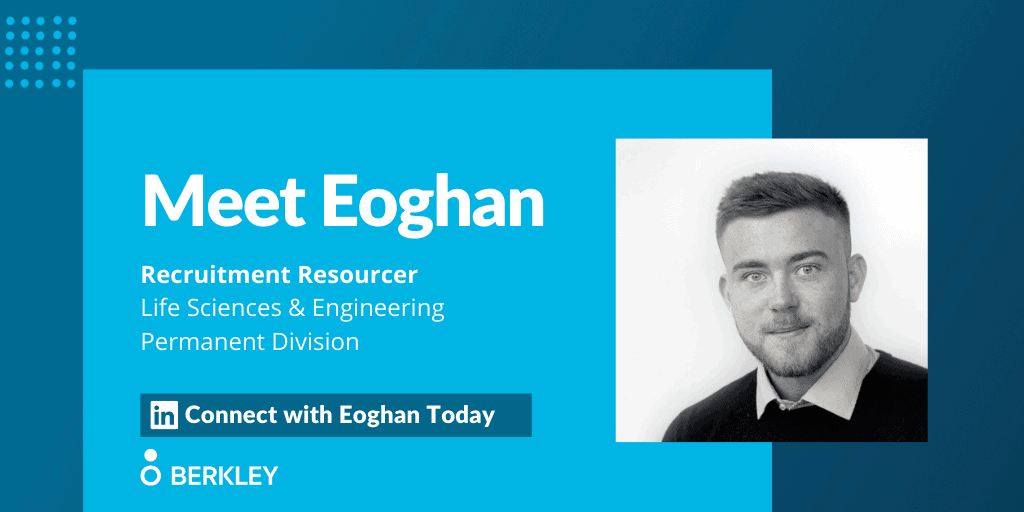
Eoghan will be returning as a Resourcer within the Life Sciences & Engineering team and will be focusing on roles in the areas of quality, manufacturing and validation. “I’m thrilled to be back working with my old colleagues and to get to know the new faces too.” He says, “I decided to come back to Berkley for the chance to hone my expertise and grow in my career. My teammates here represent some of the best recruiters in the country – in terms of industry knowledge and of the labour market – and I have a lot to learn from them.”
Tony Tynan, Operations Director of Berkley, commented:
“Michael and Eoghan return to Berkley to where they were first trained as they feel it is the best environment where they can both realise their potential. Both have huge subject matter expertise within their respective divisions which has had an immediate impact. It has been a pleasure to welcome them back to the Berkley family and we are excited to see them back on the journey with us as we continue to grow.”
https://www.berkley-group.com/wp-content/uploads/2020/09/EM.jpg400495Robert Hawkeshttps://www.berkley-group.com/wp-content/uploads/2026/05/Berkley-Group-Logo-2026.svgRobert Hawkes2020-09-07 10:35:592020-11-23 12:51:17Berkley Welcomes the Return of Michael & Eoghan
Need to update your LinkedIn profile picture? Check out this infographic for a comprehensive guide on how to take a professional image that reflects your personal brand. This infographic takes you through the do’s and don’ts of taking a photo for LinkedIn. It also gives a handy overview of the technical specs you need to be aware of and recommends some useful tools. For additional advice, why not check out our guide “How To Improve Your LinkedIn Profile for 2022.”
LinkedIn’s search function is an essential tool for recruiters and employers seeking candidates in 2020. The below infographic offers practical advice on how to ensure that you appear at the top of their search results and offers a jargon-free introduction into the world of Search Engine Optimisation (SEO). For more tips and tricks, take a look at our guide “How To Improve Your LinkedIn Profile for 2022“.
https://www.berkley-group.com/wp-content/uploads/2020/09/inlytics-linkedin-analytics-tool-RJT2EWPR0d0-unsplash-scaled-e1600686581988.jpg399494Robert Hawkeshttps://www.berkley-group.com/wp-content/uploads/2026/05/Berkley-Group-Logo-2026.svgRobert Hawkes2020-09-01 10:19:142021-11-22 14:15:47How to Optimise Your LinkedIn Profile for Search [Infographic]
We may request cookies to be set on your device. We use cookies to let us know when you visit our websites, how you interact with us, to enrich your user experience, and to customize your relationship with our website.
Click on the different category headings to find out more. You can also change some of your preferences. Note that blocking some types of cookies may impact your experience on our websites and the services we are able to offer.
Essential Website Cookies
These cookies are strictly necessary to provide you with services available through our website and to use some of its features.
Because these cookies are strictly necessary to deliver the website, refuseing them will have impact how our site functions. You always can block or delete cookies by changing your browser settings and force blocking all cookies on this website. But this will always prompt you to accept/refuse cookies when revisiting our site.
We fully respect if you want to refuse cookies but to avoid asking you again and again kindly allow us to store a cookie for that. You are free to opt out any time or opt in for other cookies to get a better experience. If you refuse cookies we will remove all set cookies in our domain.
We provide you with a list of stored cookies on your computer in our domain so you can check what we stored. Due to security reasons we are not able to show or modify cookies from other domains. You can check these in your browser security settings.
Google Analytics Cookies
These cookies collect information that is used either in aggregate form to help us understand how our website is being used or how effective our marketing campaigns are, or to help us customize our website and application for you in order to enhance your experience.
If you do not want that we track your visit to our site you can disable tracking in your browser here:
Other external services
We also use different external services like Google Webfonts, Google Maps, and external Video providers. Since these providers may collect personal data like your IP address we allow you to block them here. Please be aware that this might heavily reduce the functionality and appearance of our site. Changes will take effect once you reload the page.
Google Webfont Settings:
Google Map Settings:
Google reCaptcha Settings:
Vimeo and Youtube video embeds:
Privacy Policy
You can read about our cookies and privacy settings in detail on our Privacy Policy Page.









![How to Optimise Your LinkedIn Profile for Search [Infographic]](https://www.berkley-group.com/wp-content/uploads/2020/09/Infographic_-LinkedIn-SEO-v2-scaled.jpg)